

It’s restless in Dutch society and within many organizations; both are facing significant challenges. These challenges call for leaders who are not only decisive but also capable of empathizing with the interests of citizens and employees and connecting with them.
In this article, Esther critically examines how political and organizational leaders often opt for swift decision-making. They often label this as “high-performance” leadership because it appears action-oriented and decisive, but this approach is not the magical formula that will elevate our country or organizations to a high-performance level. If residents and employees do not recognize themselves in the measures, trust and support are lacking, and goals and solutions remain out of reach. A strong plea is made for a long-term vision and an empathetic form of leadership on the road to sustainable success, with the HPO framework providing guidance.
As a strategic advisor and trainer, I’ve noticed that nearly every organization is currently facing significant challenges. These challenges are diverse: digital transformations, staff shortages, climate-related issues, energy transitions, improving efficiency, financial matters, integration of business units, increasing distrust from stakeholders, and the adoption of hybrid forms of collaboration. All these matters require a thoughtful approach.
Research from Gartner shows that in 2016, organizations on average implemented two organization-wide transformations. By 2022, this number had risen to ten on average, putting considerable pressure on organizations. Leaders must react quickly and execute effectively while also keeping their organizations flexible and resilient to continuously innovate and transform as a whole.
Connect, Develop, and Engage
The pace of transformation seems to struggle to align with employees who desire more psychological safety, deeper connections, authentic interactions, and recognition. Research from The Workforce Institute indicates that nine out of ten leaders in organizations believe that their organization provides all of this, positively influencing the mental health of their employees. However, 70% of employees in those same organizations state that the organization and their immediate supervisor have a greater negative impact on their mental health than their life partner. They long for work environments where organizations and their leaders actively contribute to their personal growth and harness their full potential. It’s an important signal: employees want more recognition and to be taken seriously and are not necessarily willing to go along with all changes automatically. They want a voice in those changes and attention to their personal interests.
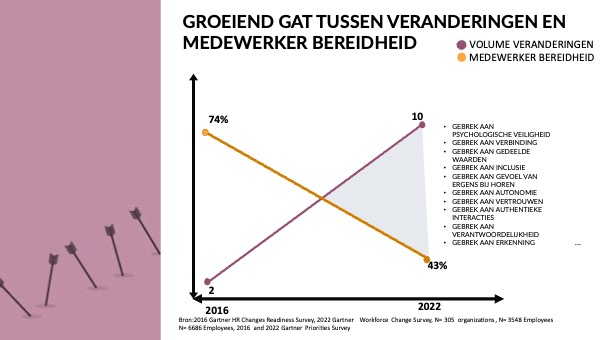
Image: Gartner Research on the Growing Gap Between Necessary Changes and Employee Engagement. Esther argues in the article that the same challenge applies in our society.
The Dual Challenge
The challenge is not to lose sight of humanity at the necessary speed, and even stronger: to actively involve them in shaping solutions and keeping them engaged in the process. Many changes and transformations can only succeed if all employees are fully committed; they must become active participants in the solution. Without this, they will not easily join the desired movement (or may even actively oppose it). This phenomenon manifests itself in almost every organization I encounter. Leaders fail to effectively communicate the message of necessity and miss the trust and full commitment of the employees who must implement the transformations. It can paralyze organizations, and leaders sometimes seem to be backed into a corner.
Similar Challenges in Dutch Society
This situation also appears to occur in our society as a whole. The Netherlands faces enormous challenges in climate, trust, aging, income inequality, and essential services. There is an urgent need for concrete steps to create a sustainable future together. The recent elections have made it clear that many people feel unheard and have little confidence in the current leaders and the existing (democratic) system. In their call for recognition, many voters have made more extreme choices, sometimes impulsively. They want to be taken seriously and demand solutions to problems that have remained unresolved for years, such as the childcare benefits scandal, gas extraction in Groningen, housing shortages, and the nitrogen dossier. The credibility of and trust in Dutch political leaders to solve these issues promptly has steadily declined, and it seems like a long road to restoring this trust.
The Gap Between Decision-Making and Interests
The recent elections reflect the societal unrest that I often encounter at the organizational level as well. Both citizens and employees of organizations crave more attention, recognition, and customization. They want to be taken seriously and involved in finding solutions that affect their interests, well-being, and work.
In their haste to address the many challenges, leaders often make hasty decisions that may seem beneficial in the short term but have harmful long-term consequences. In politics, a possible example is Kuiper’s decision to consolidate heart surgery. Concerned hospitals want more collaboration to prevent closure and appealed to the judge, who ruled that it is unclear whether this decision is necessary and proportionate. But also, the importance of short-term gas extraction the happiness of the people of Groningen, and the desire to combat fraud that led to the childcare benefits scandal are examples.
In organizations, I often encounter examples such as:
- Implementing efficiency improvements without consultation, leads to sudden restructuring, resulting in disrupted work relationships and feelings of not being taken seriously by employees.
- To address staff shortages, international recruitment was utilized. The team unexpectedly gained English-speaking colleagues, meaning they now had to communicate in English at work without prior discussion. This led to misunderstanding, and the team felt overwhelmed and not taken seriously.
- The introduction of new production lines without prior discussion about future retraining and career development of existing employees, who feel discarded after years of loyal service.
Do you recognize similar situations in your organization?
High Performance Requires Challenge and Human-Centeredness
What then is the right approach?
To understand what often goes wrong and how leaders can bridge the gap between organizational goals and employee engagement, we can learn from highly successful organizations. The HPO Center, where I am part of the expert team, has been studying organizations that have outperformed their competitors strategically and financially for five to ten years since 2007. This research identified five pillars crucial to their success: quality of management and employees, continuous improvement and innovation, long-term vision coupled with short-term action, and focus on stakeholders such as customers, employees, financiers, and suppliers.
What often goes wrong is that leaders use the term ‘high performance’ to enforce results through short-term actions. They define high performance in terms of speed, exerting pressure, and maximizing profit. However, this is not the right approach to achieve sustainable success in the long term. In excellent organizations, leaders combine short-term actions with a long-term vision and involve their employees in it. They are responsible for both the results and the well-being of their people. The quality of their leadership is characterized by a healthy balance between ‘caring’ and ‘daring’: they set clear goals, delegate responsibilities, and focus on results, but they also inspire, involve, and coach their employees. If you want to know more, read the article on the Two Legs of Good Leadership: https://www.esthermollema.nl/twee-benen-van-goed-leiderschap).
Investing in Employees is Crucial
The conclusion is clear: implementing and succeeding in transformations requires leaders and teams who pay attention to each other and each other’s interests, inspire each other, and develop and grow together. This generates energy at the human and organizational level, and therefore, effectiveness. If you don’t do this, employees will resist or disengage, with serious long-term consequences.
Investing in employees is crucial: listening to their perspectives and interests, providing customization, and building trust before trust is lost. Although this may not result in quick transformations immediately, it will be the key to successfully implementing transformations in the long term without having to initiate new transformations constantly.
I wish our society and organizations human-centered leaders who have the courage to lead not only in the short term but also in the long term, inspiring and guiding. Major transformations need to be approached with patience and attention so that people can and want to take the next steps with confidence in a constantly changing and uncertain world.