The two legs of good leadership in 2026: reflections from practice

The two legs of good leadership in 2026: reflections from practice
Esther Mollema Caring Daring


This article is an update of two previously written blogs on the same topic. In this article, we look at why daring leaders are unable to deliver on the many transformations in organizations and how caring leadership can be trained through micromoments.

Good leadership is often described in terms of styles, competencies and models. In practice, however, I see something much simpler: effective leaders stand firmly on two legs.

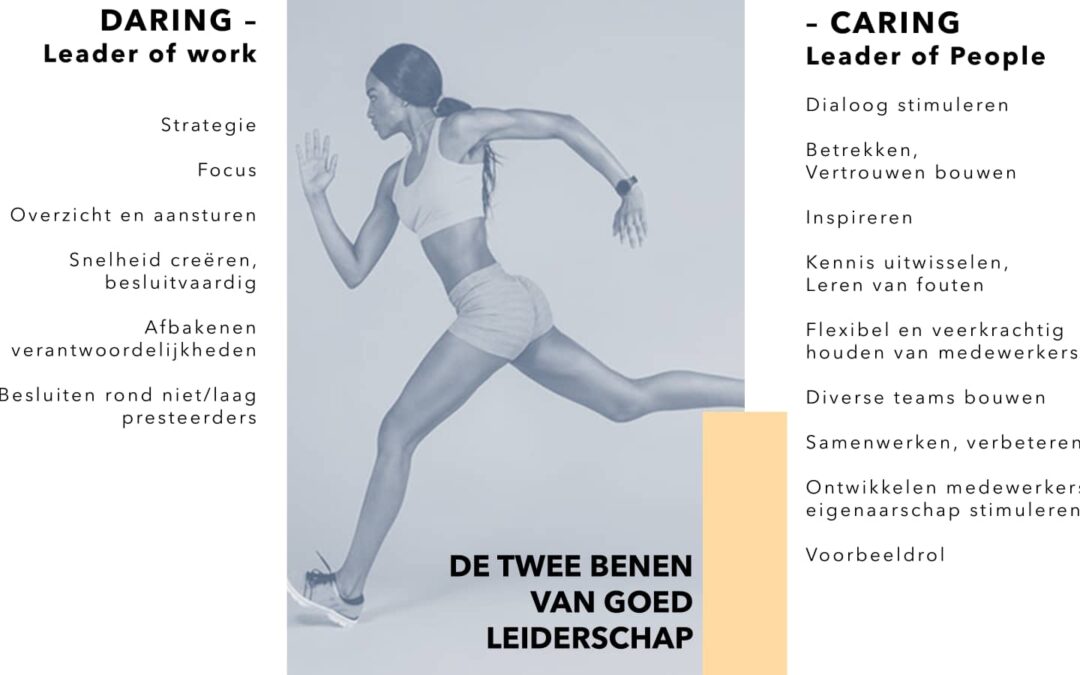
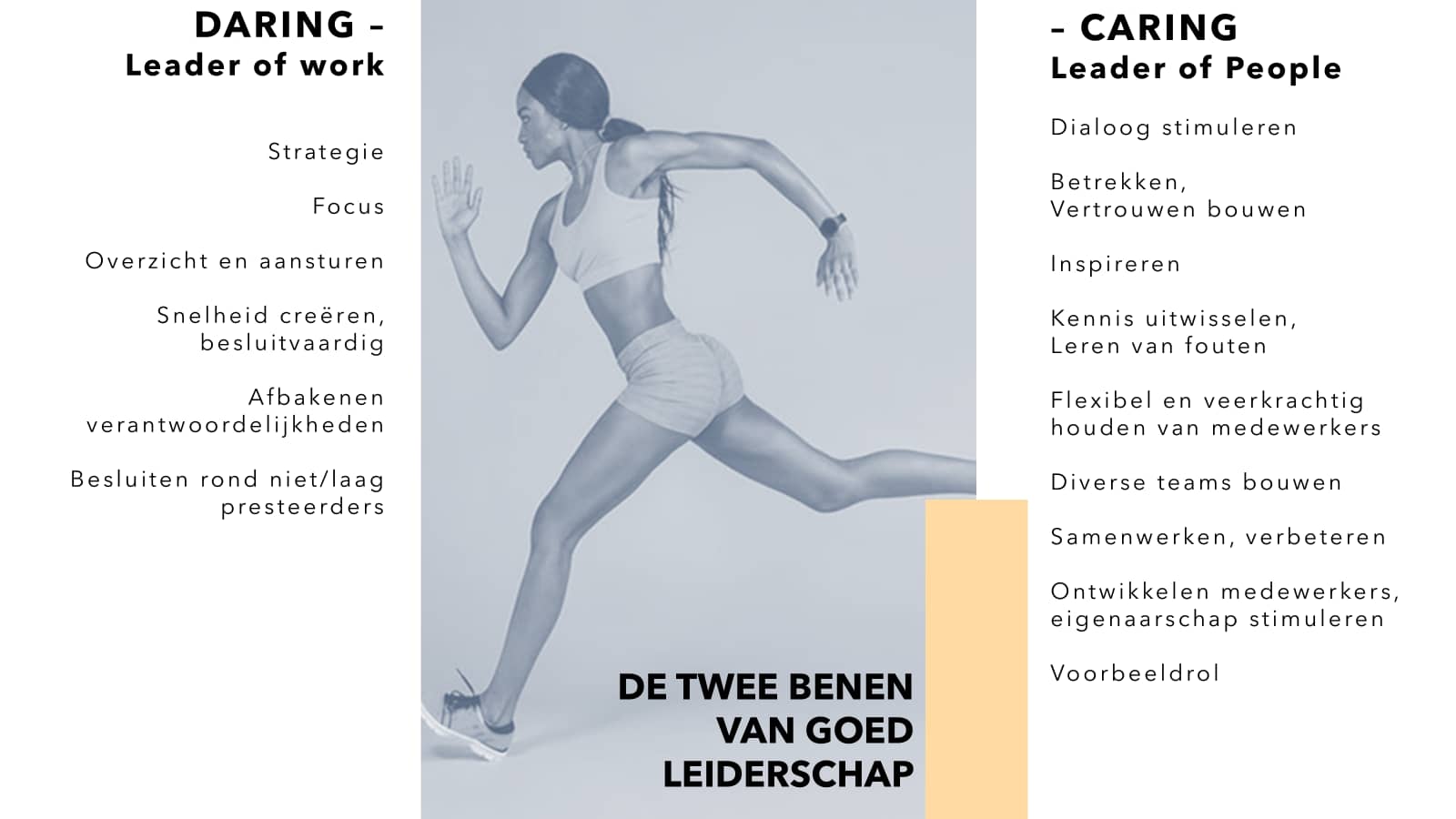
I call those two legs daring and caring. Together, they form the foundation of good leadership. They are not separate qualities you can choose from, but two connected tasks. One cannot exist without the other. Only together do they enable leaders to make progress and achieve sustainable results in teams and organizations.

Leadership on two legs

One leg represents what I call the daring side of leadership: the ability to provide direction, make decisions and take responsibility for the collective result. Daring leadership means consciously using the formal power you have been given in your role to move the work forward. With this leg, you create clarity, focus and pace as a leader. You make clear what matters, which choices are being made and what is expected of people. You prevent topics from floating around, address what needs to improve and make sure that agreements are not only made, but also followed up on. Of course, you discuss a lot with the team and listen to different perspectives. But leadership also requires you to make decisions on time. Not endlessly continuing to consult, but offering clarity about what will and will not happen. Because ambiguity can sometimes feel kind, but in practice it often leads to delay, frustration and hassle.

The other leg represents the caring side of leadership: the ability to pay attention to people, their development and the quality of collaboration. Caring leadership means that you do not only look at what needs to be done, but also at what people need in order to contribute well. With this leg, you create an environment as a leader in which team members can grow, learn and dare to share their perspective. You listen actively, ask questions, coach where needed and help people develop their talents further. This creates a way of working together in which people feel seen, strengthen one another and learn from one another more easily. That attention to the human aspect ultimately makes decisions better. Not because every feeling should be leading, but because good decisions also require insight into what is going on with people. What concerns are present? What knowledge is still left unspoken? Who is looking at the problem from a different perspective?

The model of these two legs emerged for me in 2022, thanks to Joy Lodarmasse from Alliander, who introduced the metaphor. By now, it is used by many organizations and coaches, precisely because it makes clear in one image what good leadership requires: not a choice between caring and daring, but the development of both qualities in connection with one another.

In practice, however, we see that many leaders mainly develop one of the two legs. Often, this is the behaviour that made them successful in the first place. The leader who is good at connecting keeps caring and aligning. The leader who is strong at giving direction keeps pushing and making decisions. What was once a strength eventually becomes a limitation.

Good leadership therefore requires not only becoming stronger in what you can already do, but also developing the leg that feels less natural. That is where balance emerges.

Both legs in practice

Over the past years, my conviction has only grown stronger: organizations still focus too little on caring leadership, while the pressure on leaders is greater than ever. For a long time, leaders were mainly selected and rewarded for their daring qualities: giving direction, making decisions and achieving results. In many organizations, we therefore see senior leaders who are good at this. They develop strategy, create focus and ensure pace. This has brought organizations a lot, and for a long time it also seemed to be the route to success.

At the same time, an increasingly visible problem is now emerging. This particular group of leaders often struggles to make major changes truly succeed. Not because the plans are wrong, but because there is insufficient insight into what is happening among the people who have to carry out those plans.

Research has shown for years that a large share of organizational changes fail or fall short of expectations. The cause rarely lies in the strategy itself, but much more often in the way people are taken along. Or more precisely: in the extent to which leaders understand what is happening beneath the surface. Daring leaders often genuinely feel that things are going well. The direction is clear, the planning is in place and the goals are clear. But doubt, uncertainty or resistance are not always expressed. And what is not expressed is quickly interpreted as not being there. Silence is not agreement. That is exactly where things go wrong. What feels to leaders like “silence” or “agreement” is in reality often hesitation, lack of clarity or a lack of safety to speak up. Signals that are crucial for the success of a change therefore remain invisible.

In organizations where several changes are taking place at the same time, and there are many of them, this gap only grows wider. The difference between leaders who are strong at giving direction and the lack of attention for what is happening among people becomes increasingly tangible.

The thinking error of a generation of daring leaders

An important part of this problem lies in the way we have defined leadership for a long time. Caring was often seen as something extra: a team outing, an inspiring speech or a moment of attention at set times. Not a core part of leadership, but something added on.

In addition, daring leaders in the Netherlands operate in a specific cultural context. We communicate relatively directly and explicitly. What is not said quickly seems not to exist. But that is exactly where the thinking error lies. In many situations, what people really think or feel is precisely not expressed directly. Not because it is not there, but because it feels tense, because the context does not feel safe enough, or because people have not yet found the right words.

Leaders who lean heavily on daring miss this layer more quickly. They mainly listen to what is being said, while a large part of the information lies precisely in what is not being said. In more group oriented and caring cultures, leaders are often more used to reading between the lines and picking up subtle signals. That ability is becoming increasingly important in complex changes.

What is not said determines what happens

When objections are not expressed, they often do not exist for others either, especially not for leaders who are strongly focused on results. At the same time, those unspoken signals contain valuable information.

Connection is found in the micromoments

Connection does not arise through large, visible gestures, but through what happens between people every day. In small, subtle signals during interactions. Often, it begins with a leader who shows something of themselves, dares to slow down and takes a vulnerable and learning stance.

Caring leaders act from the understanding that people perform better when they feel seen, heard and valued. Not as an extra, but as a condition for being able to do good work. In teams, people are constantly, often without being aware of it, looking for signals that confirm that they belong and that their contribution matters. That search does not stop after one good conversation, but returns again and again in daily work.

That need for connection is deeply rooted in our human system. We have no armour or claws. Our strength for survival lies in collaboration. Alone we were vulnerable, together we had a chance. That logic still influences how our brain responds, also in a modern work environment.

Micromoments: where the difference is made

Caring leadership becomes visible in what we call micromoments: small, often fleeting interactions that repeat throughout the day and have a major effect on the quality of collaboration. These are moments in which someone feels seen, in which someone is truly listened to, in which space is created for another perspective or in which something is named that has not yet been made explicit.

Precisely because these moments are so small and everyday, they are easily overlooked. They are not included in schedules, require no extra resources and are rarely evaluated explicitly. Yet they strongly determine how safe, engaged and energetic a team feels and functions. When these micromoments are present, a different dynamic emerges. People speak up, contribute ideas and take responsibility. When they are absent, hesitation and distance arise instead.

The difference often lies in seemingly small choices: a question that is or is not asked, a response that is or is not given, or the moment when a leader decides to pause instead of moving on. Caring leadership is therefore not a “soft” addition, but an essential part of effective leadership.

Daring reconsidered

The importance of caring does not mean that the daring leg becomes less important. On the contrary, especially in times of change, it is necessary for leaders to provide direction, make choices and ensure progress. Without that clarity, uncertainty and delay arise. At the same time, in a context of continuous change, it is no longer enough to be strong only in analysing and making decisions. Nor is caring leadership enough on its own.

The challenge lies in developing both qualities in connection with one another. When daring and caring reinforce one another, leadership emerges that both gives direction and creates connection. It offers clarity and leaves room for the input of others.

In practice, that balance proves difficult. Many leaders develop mainly along one of the two dimensions. What made them successful before can later become precisely what limits them.

Caring leadership is developed in practice

Caring leadership is difficult to develop through classical training alone. Knowledge and awareness help, but ultimately this form of leadership emerges in daily interaction with others. It requires attention and practice: listening to what is going on, staying curious and repeatedly asking yourself what the other person needs in order to move forward. That development does not only take place at work, but also beyond it. In every situation where there is a choice to either give attention or not. It is precisely in those micromoments that leadership takes shape. By recognizing them and consciously paying attention to them, new habits emerge.

Which leg do you stand on?

Leaders who are mainly strong in daring can be highly capable in terms of content, and still not be the leaders needed for the transformations organizations are now facing.

The question that helps here is simple: which leg do you mainly lean on as a leader? And how do the people around you see that? The invitation is to develop both legs. Not only in theory, but especially in daily practice. In the many small moments in which leadership becomes visible. The major changes organizations are facing are not only realized through strategies and plans, but through behaviour. In how people collaborate and how they interact with one another. Leaders who learn to see those moments and consciously shape them build, step by step, teams that not only perform better, but are also more resilient, experience more energy and remain connected for longer.


Inclusion is contagious

Inclusion is contagious

Gedrag is besmettelijk Esther Mollema

Image: Juan Genovés 


How kindness, happiness and cooperation spread like a spark from the campfire

Kindness can seem small: a smile, a compliment, a helping hand. But small gestures can have a huge reach. One act of kindness can set off a chain reaction that affects people up to three social steps away. Inclusion and positivity turn out to be literally contagious.

The campfire as a starting point

Human beings have lived in groups since prehistoric times. Living together was the smartest survival strategy: together you could keep watch, hunt, share food and protect one another. Around the campfire, cooperation emerged, and our brain adapted to that.

The human brain developed into a social organ, oriented towards safety, connection and cooperation. Even though we now live in offices, cities and digital networks, our brain has largely stayed the same. We want to belong, we are sensitive to exclusion and we look for recognition and appreciation within a group.

But that same ancient brain is seriously tested today. We work in large, changing teams with people we barely know. Our brain does not automatically experience that as safe.

“We are still campfire beings who long for connection, only the campfire has become digital in many places.”

Behaviour is contagious

People mirror their environment. Not consciously, but instinctively. This was shown in the Framingham Heart Study, in which almost five thousand people were followed for twenty years. In order to really understand why some people developed heart problems and others did not, the researchers kept very detailed information about the lives of the participants, their health, lifestyle, environment and also who they were in contact with (family, neighbours, friends).

What did they find? How much you eat and whether you smoke is strongly influenced by what the people around you eat and whether they smoke. Your chance of obesity increases enormously if people in your environment are obese. The same applies to smoking. Whether you smoked was strongly determined by your environment, and the same was true for whether you stopped smoking. If your partner stopped smoking, your chance of quitting increased by 67 per cent. If a close colleague stopped smoking, your chance of continuing to smoke fell by 34 per cent.

Our environment determines what we see as normal. Behaviours and habits such as eating and smoking spread not only via direct friends, but also via friends of friends, up to three steps away.

Happiness and kindness spread in exactly the same way

Christakis and Fowler, who studied the same data set, discovered that happiness and kindness are contagious as well.

• You become 15 per cent happier when a direct friend or colleague becomes happier.
• You become 10 per cent happier when a friend of that friend becomes happier.
• You still become 6 per cent happier when it concerns someone who is yet another step removed from you.

In other words: your mood and behaviour have a measurable impact on others. In teams where respect, helpfulness and trust are the norm, that behaviour spreads naturally. Happiness and kindness reinforce one another.

“With your positive behaviour you not only make yourself happier, you also unconsciously influence the people around you.”

How kindness becomes a social norm

Researchers Nowak and Sigmund (Nature, 2005) discovered how cooperation and kindness can develop even in groups where people are not naturally very helpful towards one another.

Their theory of indirect reciprocity shows that people like to help because it strengthens their reputation:

“I do not help you because you helped me, but because others see that I help you, and therefore will want to help me later.”

That fits perfectly with how our brain has developed. We are naturally strongly focused on safety within the group, because that safety once guaranteed our survival. You may not always help someone out of convenience or sympathy, you are busy, you do not know the person, or you do not really like them, but your brain still encourages you to do it. Why? Because visible helpful behaviour gives you a positive reputation. And people with a good reputation are more likely to be trusted, valued and invited to cooperate.

When we see a lot of positive behaviour around us, we start mirroring it automatically. In groups where people regularly help one another, that behaviour becomes the norm, and it is precisely the person who does not help who stands out. In such environments a culture emerges in which kindness and involvement become the standard, the natural language of the group.

In environments where helpfulness is visible and valued, a culture emerges in which not helping is what stands out. Kindness then becomes the language of the group.

You can start the movement today

Real change rarely starts with a big plan or an inspirational session. It starts with one person who does something differently and keeps going. Small, deliberate actions that are repeated daily often have more impact than big, loudly announced programmes.

Anyone who acts with attention, kindness and involvement sets a movement in motion without realising it. Others mirror that behaviour and pick up the tone, energy and attitude. A kind gesture makes it safer for others to be kind as well. A listening ear invites openness. Step by step, this creates a culture of trust.

You do not need to be in a leadership position to create change. With your conscious choices you help set the tone in your team. Your actions can create an environment in which people feel safe, seen and involved, and therefore collaborate and learn better.

How can you strengthen the norm of kindness?

Here are a few ideas to speed up the building of an inclusive culture:

• Compliment people who help others and name their contribution. Positive attention strengthens desired behaviour.
• Make visible how kind behaviour improves cooperation and shifts the atmosphere. What is seen is repeated.
• Focus on what goes well. Pay attention to the examples that strengthen the norm, not to the exceptions that deviate from it, because unfortunately those can also become contagious if you give them a lot of attention.

When helpful behaviour is consistently valued, it naturally grows into the standard. Kindness continues to exist when it brings social advantage and is visible.

In such an environment people are not only kind because they want to be,
but because it is the natural language of the group,
a language in which trust, cooperation and joy reinforce one another.

Will you start your movement today?


Our Takeaways from the Nordic Business Forum

Our Takeaways from the Nordic Business Forum

Last month we attended the Nordic Business Forum in Helsinki. These are the insights that stayed with us:

We are entering uncertain times where change is the only constant.

It is tempting to see AI and other developments as one big storm to protect yourself against. But this change is not a storm that will pass. It is a climate that is permanently shifting. Turbulence has become the new normal. The real problem? It arises when you try to solve the future with the logic of yesterday.

We will have to transform our organisations quickly.

Innovation will become a daily task that enables us not only to perform, but also to transform. This requires systems that look beyond tomorrow. Small steps ensure that the future does not become a gaping void, but something manageable. This way, you tackle the human tendency to turn away and instead face change head-on.

Experiment and dare to stop being “quite good.”

In times of innovation, you can only stay ahead by experimenting a lot. But real progress only happens when you dare to choose. Projects that are quite good, that deliver something but not enough, must be stopped. Letting go of these “quite good” projects creates the time and space to develop the truly great ones.

How do you get people on board?

You do not retain talent by simply telling them what needs to be done. You get people on board by making them part of the change. Provide learning opportunities so that they can lead the transformation themselves. That creates the loyalty you will need in the times ahead.

Leading in the age of AI requires heart.

We are used to leading mainly with our heads: achieving goals, rewarding people, managing results. But our primitive brain experiences change as stressful and threatening. Building real connection and trust is the only way to guide teams through continuous change.

Your brain perceives change as a risk.

The status quo has a powerful pull. What once worked provides a false sense of security. People only truly move when something is 2.6 times better than before. Guidance and empathy are essential to make that happen.

Uncertainty leads to poor decisions.

When people feel insecure, they lose perspective. The brain switches to flight mode, as if a tiger were chasing you. That is when you rarely make the best decisions. You act out of fear or postpone choices indefinitely. Leadership therefore also means finding ways to break through that stress.

The bigger the culture, the bigger the shadow.

Cultures that are too “caring” are often the hardest to change. When people are too nice to each other, honest feedback disappears. Investing in strong feedback systems – ones that also develop the “daring” side of leadership – becomes essential.

Replace judgement with curiosity.

The newest generation often hears what they are like through headlines or snap judgements, without anyone really asking why. They are expected to play by rules that were made long ago, yet they do so in their own way. When you judge them without involving them, you take away their basic needs for connection, meaning, and belonging. And that means you will not get these much-needed employees on board.

This turbulent time calls for new leaders

This turbulent time calls for new leaders

And chances are, these leaders are already working for you – you just have not discovered them yet.

We are entering an era of unprecedented technological change. Artificial Intelligence (AI) will strongly transform organisations. It will become a rat race to apply technology effectively. Many leaders feel uncertain about whether they are making the right choices for their organisations (source: Gartner). The current geopolitical unrest also creates insecurity among people at all levels within organisations (source: Deloitte).

The organisations that will weather these storms are not necessarily the smartest or the fastest. They are the ones that make survival choices by drawing on a wide range of perspectives and disciplines. The winning organisations also have leaders who can engage employees with both their head and their heart. They are the leaders who give direction to the bigger picture and connect people on an emotional level. These leaders may not always be easy to find, yet they are there. They often already work within your organisation but are not featured in talent reviews or succession plans. I hope your organisation is already recognising leaders from one of the following three groups:

Engaged parents
Simon Sinek points out that engaged parents make better leaders. Where else do you learn the subtle balance between caring and daring leadership as well as in raising a child? Sinek even argues that women are therefore often the better leaders. Yet many organisations still reward parents who are rarely at home due to work obligations and who hardly get to practise the caring and daring balance (see our article) with promotions to higher leadership roles.

Empty nesters
We also seem to have forgotten how much emotional intelligence people develop through life itself. Through grief, setbacks, and economic uncertainty, we learn to put things into perspective and support others. With their life experience, empty nesters are ideally suited for leadership roles (HBR). Yet people over 50 are often no longer included on leadership potential lists and are still too often dismissed during recruitment purely because of their age.

Culturally diverse professionals
People with cultural backgrounds outside Northern Europe are often better trained from a young age to read non-verbal signals. The Dutch, by contrast, are typically trained to communicate verbally and often miss the undercurrent of emotions and sentiments within organisations or among clients. In the upcoming transformation, we will greatly need these leadership qualities. Yet many organisations still only appreciate culturally diverse professionals once they have adapted their behaviour to the direct Dutch culture.

It is time to let go of old ideas about what makes a good leader to guide us through the storm. I hope your organisation creates space for new leaders, including engaged parents, wise veterans, and those who can sense the undercurrent. They bring qualities no organisation can do without.

Inclusion doesn’t start with policy. It starts with a sentence.

Inclusion doesn’t start with policy. It starts with a sentence.

Inclusie begint niet met beleid. Het begint met een zinnetje. Esther Mollema


Last year, it finally clicked for us: if we really want to move forward with inclusion, we need to talk about it less, and do it more. Not just in policy documents or strategy sessions, but especially in the small, everyday moments in between. Inclusion doesn’t start in formal settings; it starts in the hallway. By the coffee machine. In every meeting. It lives in what you say, what you leave unsaid, and what you choose to notice.

From talking about inclusion to actually doing it.


Inclusion is the key to better teamwork. Teams where people truly feel seen and valued are more enthusiastic, creative, and engaged. Inclusive collaboration isn’t just more pleasant, it’s essential if you really want to understand and serve your clients, customers, or community.


Still, inclusion doesn’t happen automatically. Our brains are wired to think in boxes and look for ways to belong. That’s human, but it can lead to others being excluded. Often unintentionally, but with real impact.

Maybe you’re already doing your absolute best as a colleague or leader, and yet it feels like your team has more potential. And you’re probably right. Diversity starts with hiring, but inclusion requires daily action. Not just at the top, especially on the work floor. Inclusive teams grow from a culture where everyone is invited to contribute. And in that culture, it’s the small moments that make the biggest difference.


Inclusion starts with action.


Below are a few examples of micromoments: small, intentional actions that show someone you see them, value them, and want to include them. Not during the official moments, but in between. In an aside. In a silence where someone finally dares to speak. In a question you hadn’t thought to ask before. That’s where change begins.


In the sentence:
“How do you think I handled this?”

In the gesture:
“Hold on, I’m putting my phone away.”

In the recognition:
“I see what you’re doing for the team, and I appreciate it.”

In the check-in:
“Isn’t this too much work on your plate?”

In the invitation to contribute:
“What are we still missing?”


In the courage to name discomfort:
“That joke didn’t feel right. Humor should be fun for everyone.”

In the willingness to be open:
“Why don’t we just ask them instead of assuming?”

In the appreciation of honesty:
“Thank you for your honesty — it says something good about you.”


Why the small moments matter

Micromoments do something to people. A single act of kindness can already trigger feel-good hormones, not just in the person who receives it, but also in the person who gives it and in anyone who witnesses it. No gesture is ever wasted.

And it shows in the data. Employees who regularly experience micromoments report up to 76% more connection (Porath et al., 2015), 71% more energy (Stanchak, 2024), and 73% more commitment to achieving shared goals (Porath et al., 2015). Teams where micromoments are the norm see lower turnover (McGonagle, 2014), greater psychological safety (Edmondson, 2009), more creativity (Carmeli, 2015), and better collaboration.

But one kind remark doesn’t build a culture. For that, something else is needed.


From good intention to lasting habit


So how do you make sure a micromoments isn’t just a lucky exception, but a reflex? How do you turn a nice gesture into a new way of working?

By turning intention into habit. Because once your behavior no longer depends on your schedule but runs from your autopilot, it becomes something that lasts.

Habits make it possible to become just a little more inclusive every day. The impact may feel small at first. But know this: one percent more inclusive each day might not sound like much, but by the end of the year, you’re 37 times more inclusive (James Clear, Atomic Habits).

And no, it doesn’t require a radical overhaul. Habits help you make a difference even when you’re busy or tired. Because whether we like it or not, we are creatures of habit.

Behavioral expert Emmalotte helps teams anchor micromoments in daily practice. She is certified in the Tiny Habits method by Stanford professor BJ Fogg and met with him in Las Vegas to ask her final questions about how to make behavioral change truly stick.

Because the real effect isn’t in the one-time compliment, but in the moment that compliment becomes natural. In the ease with which you notice who hasn’t spoken yet. In that brief check-in that’s no longer the exception, but simply how you work together.

Let us help you turn your team into habit builders, not perfect colleagues.


Why habits work


  • Because once something becomes a habit, you do it automatically — even when your mind is full.
  • Because habits are contagious — the good ones just as much as the bad ones.
  • Because small habits ripple out. Into your culture, your team, and yourself.

Real change starts small. And it can start today.
With one sentence. One gesture. One micromoment.

Those small moments are what convince your brain that inclusion is worth it. But the real difference only comes when you repeat them. Not once and done, but often enough that they become second nature. So inclusion is no longer an extra task, but a natural part of how you collaborate, lead, and grow as a team.