
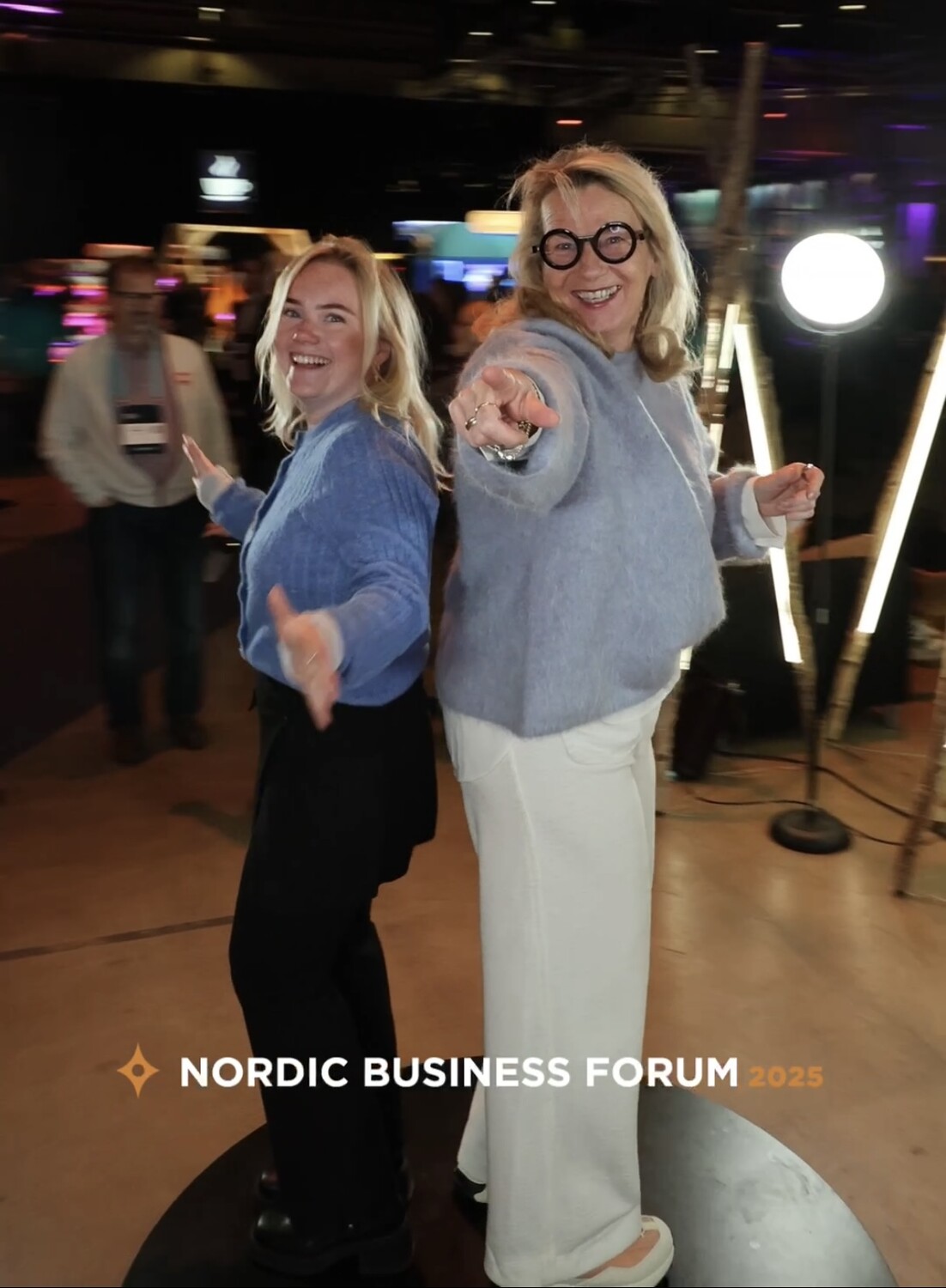
Last month we attended the Nordic Business Forum in Helsinki. These are the insights that stayed with us:
We are entering uncertain times where change is the only constant.
It is tempting to see AI and other developments as one big storm to protect yourself against. But this change is not a storm that will pass. It is a climate that is permanently shifting. Turbulence has become the new normal. The real problem? It arises when you try to solve the future with the logic of yesterday.
We will have to transform our organisations quickly.
Innovation will become a daily task that enables us not only to perform, but also to transform. This requires systems that look beyond tomorrow. Small steps ensure that the future does not become a gaping void, but something manageable. This way, you tackle the human tendency to turn away and instead face change head-on.
Experiment and dare to stop being “quite good.”
In times of innovation, you can only stay ahead by experimenting a lot. But real progress only happens when you dare to choose. Projects that are quite good, that deliver something but not enough, must be stopped. Letting go of these “quite good” projects creates the time and space to develop the truly great ones.
How do you get people on board?
You do not retain talent by simply telling them what needs to be done. You get people on board by making them part of the change. Provide learning opportunities so that they can lead the transformation themselves. That creates the loyalty you will need in the times ahead.
Leading in the age of AI requires heart.
We are used to leading mainly with our heads: achieving goals, rewarding people, managing results. But our primitive brain experiences change as stressful and threatening. Building real connection and trust is the only way to guide teams through continuous change.
Your brain perceives change as a risk.
The status quo has a powerful pull. What once worked provides a false sense of security. People only truly move when something is 2.6 times better than before. Guidance and empathy are essential to make that happen.
Uncertainty leads to poor decisions.
When people feel insecure, they lose perspective. The brain switches to flight mode, as if a tiger were chasing you. That is when you rarely make the best decisions. You act out of fear or postpone choices indefinitely. Leadership therefore also means finding ways to break through that stress.
The bigger the culture, the bigger the shadow.
Cultures that are too “caring” are often the hardest to change. When people are too nice to each other, honest feedback disappears. Investing in strong feedback systems – ones that also develop the “daring” side of leadership – becomes essential.
Replace judgement with curiosity.
The newest generation often hears what they are like through headlines or snap judgements, without anyone really asking why. They are expected to play by rules that were made long ago, yet they do so in their own way. When you judge them without involving them, you take away their basic needs for connection, meaning, and belonging. And that means you will not get these much-needed employees on board.
Schrijf je in voor mijn nieuwsbrief / Subscribe to my newsletter
Enkele keren per jaar stuur ik een nieuwsbrief, met mijn nieuwste inzichten in diversiteit & inclusie, high performance leiderschap en onbewuste vooroordelen. Ook zal ik daar mijn laatste podcasts of interviews in meenemen. Geïnteresseerd? Schrijf je dan in!
Would you like to stay informed? Then subscribe to my newsletter and I'll send you a newsletter every now and then.