
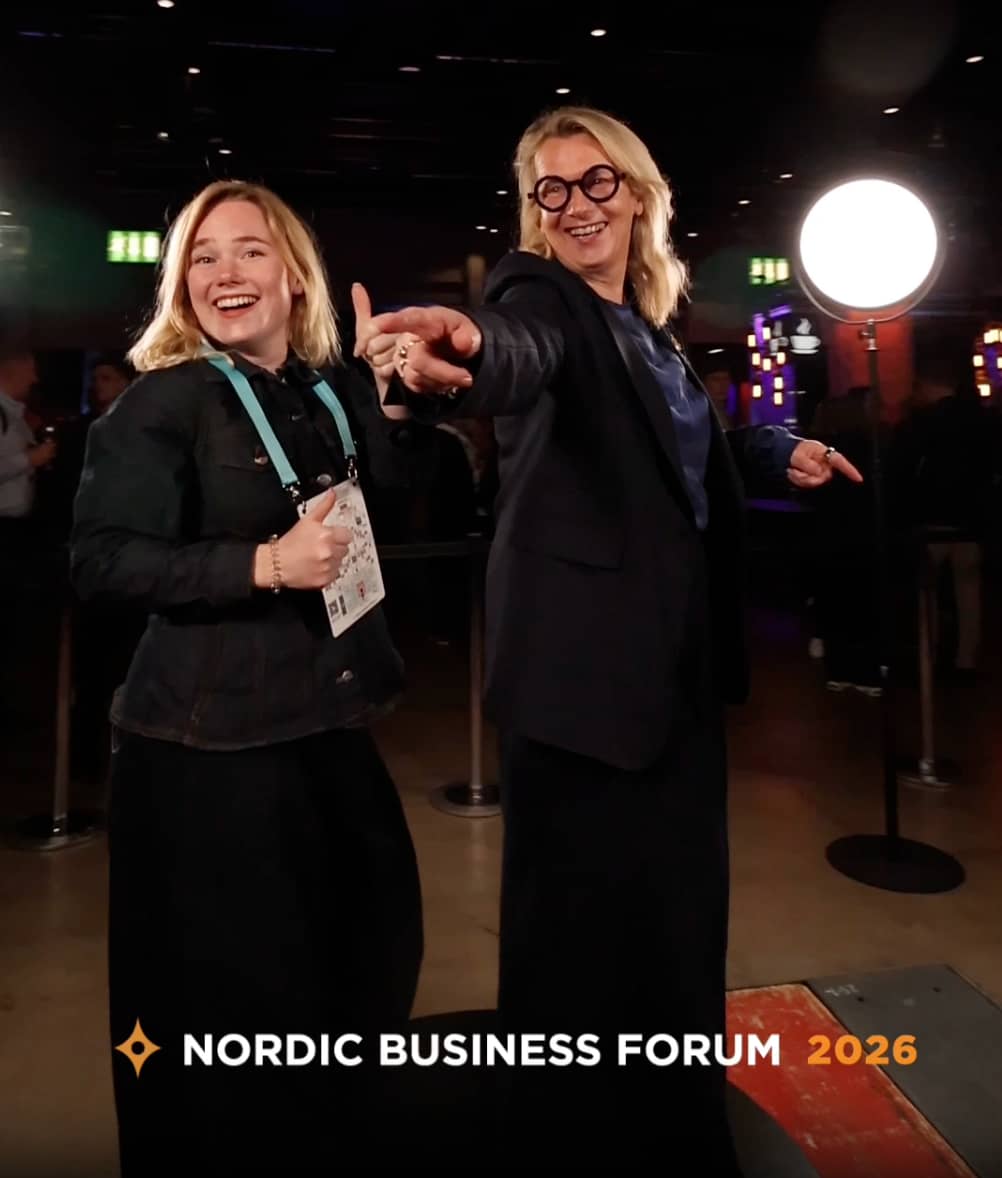
This year, we once again travelled to Helsinki for the Nordic Business Forum. A conference on that scale is always a remarkable experience. Especially in Finland, where the audience seemed to laugh hardest at jokes about how much Finns dislike small talk. At the same time, this year’s theme, The Human Edge in the age of AI, clearly resonated. At one point, one of the speakers even managed to get 8,500 people harmonising together.
We also had to laugh at the special corner for “extreme introverts”. This year, it had been renamed the corner for “extreme extroverts”, so they too would have somewhere to go in no-small-talk Finland.
We wrote down our biggest takeaways for you. These are the things we kept thinking about ourselves, and that we hope will be useful to you too. Here they are:
1. The future will require more than knowledge. It will require human qualities
If the Wright brothers had asked Claude whether they could build something that would allow people to fly, Claude would probably have said no. And if Nando Parrado, survivor of the Andes plane crash, had asked whether he and the other passengers could survive, they would probably have been written off already. Yet they survived. People are capable of doing things that seem unlikely based on existing knowledge. In an innovation economy, human qualities such as creativity, curiosity, courage and compassion will therefore only become more important.
2. The easy things are also easy not to do
Large culture programmes get a lot of attention, but it is often the small behaviours that make an organisation feel noticeably different. Steven Bartlett, host of The Diary of a CEO, for example, explained how deliberately he pays attention to small details such as the smell, music and atmosphere in his podcast studio. He even sees that as a competitive advantage: when guests feel just a little more comfortable, better conversations follow. These are exactly the kinds of things that are easy to do, but for that same reason, also easy to forget.
3. AI does not only automate work. It also automates ways of thinking, which can work against inclusive thinking
Technology is rarely neutral. The tools we use influence what we value and which behaviours become normal. If an AI tool immediately offers to summarise every long document, we may also train ourselves not to read slowly and deeply anymore. The same applies to ideas. If a chatbot gives us one answer and we stop there, while at the same time saying that diversity of perspectives matters, an interesting tension arises. So the question is not only what AI can do for us, but also: what behaviour do we want it to strengthen?
Read the full article Emmalotte wrote about AI implementation.
4. In the end, people mainly want to feel seen
Perhaps the most human message of the conference came from Oprah Winfrey. Whether she was interviewing Beyoncé, Barack Obama or a convicted murderer, she said the same question would often come afterwards: How did I do? Did what I say get through? That need for recognition is surprisingly universal. Especially in the uncertain times we are living in, we need one another.
5. With AI, the choice becomes sharper: efficiency or human experience
AI makes it possible to remove more and more friction from processes. But not everything that can be made more efficient necessarily should be. Organisations will have to make more conscious choices about where technology should make work faster and easier, and where human contact, attention and experience are exactly what make the difference.