Queer Allyship Cannot Be Scheduled
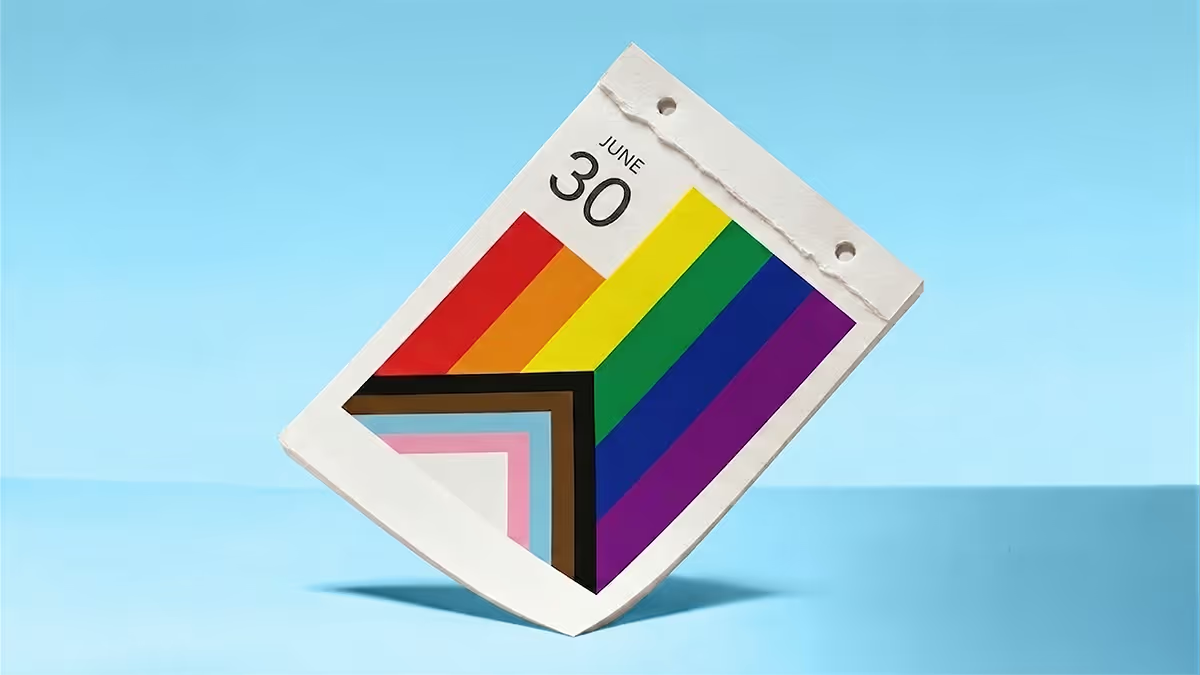
Image: HBR/ Getty Images
Next week, organisational profile pictures will turn every shade between red and purple for a month, calendars will be filled with training sessions, and a new round of rainbow keychains will be handed out. A great deal has been fought for to establish this month of recognition for the LGBTQIA+ community in the workplace. So why would we have anything against it?
After all, we are the ones who emphasise how important it is for people to feel valued, and for organisations to actively contribute to that. Our brains are constantly scanning for these kinds of signals, often more than we realise. If you want people to perform at their best, they need to feel that they belong. Yet it turns out that timing matters in that search.
Research is helping us understand more and more about how to create genuine connection with employees, and with one another. And this is where a themed month often falls short. Precisely because the signals are so concentrated and abundant during that period, they can come across as less authentic to the people they are intended for. They feel less like genuine attention and more like something being ticked off a checklist. As a result, they do not automatically contribute to a stronger sense of engagement or a deeper commitment to the organisation.
This relates to a phenomenon we describe in our book Micromoments: the tendency of organisations to try to capture connection in what we call “macromoments”. Think of themed days, themed weeks, or themed months. Think of training sessions, social events, and Christmas dinners. Think of office basements where table tennis tables appear and hallways lined with portraits of employees, from interns to CEOs. All of these are ways of showing that organisations value their employees and that there is room for connection and interaction.
These initiatives certainly have value. But there is also something deceptive about relying on such macromoments. They make us believe that connection can be organised through a series of planned events in a calendar or by placing highly visible signals in the workplace. As if connection is something that can be created by purchasing something or ticking a box. Yet macromoments on their own rarely have a lasting effect. Table tennis tables and rainbow decals on the floor lose their impact the more often you walk past them, and the course of a themed month becomes predictable if you have been around for a few years.
During Pride Month, people may recognise themselves in their organisation’s expressions of support and genuinely feel seen for a moment. But that moment is fleeting. Ultimately, the feeling of recognition is determined by what happens afterwards in the day to day collaboration itself. That training session from a while ago, or the portrait gallery you just walked past, says very little about whether every voice is heard in meetings or whether certain perspectives consistently receive less space. A signal in the hallway makes very little difference if the accompanying micromoments, small, repeated actions, are missing.
In fact, when a visible gesture is not supported by concrete behaviour or policy, the effect can even backfire. Employees may start to feel that the organisation wants to be seen as diverse but does not truly live those values. That organisations would rather invest energy in creating the impression that everyone already feels welcome than in doing the structural work required to actually create that culture.
Large gestures, such as those surrounding Pride, may reassure scanning brains for a moment, but they are often a lazy solution. Recognition does not work in peaks; it works in patterns. It is not created by what happens occasionally, but by what is repeated. Not by what hangs on the wall or what is said once. It lives in the way people interact every day: who is looked at, who is included, who is heard, and who is supported when it matters.
Macromoments cannot compensate for feelings of exclusion at work. People who feel excluded are rarely convinced otherwise by a single incident. More often, those feelings are the result of an accumulation of small moments. One grand gesture, however well intentioned, rarely breaks that pattern. Repair therefore does not require one impressive event, such as a training session or an office full of rainbow symbols, but repeated signals from colleagues that together tell a new story.
The training sessions held during Pride Month are certainly a valuable starting point. They contribute to awareness and can lay the foundation for allyship throughout the rest of the year. Yet when we take a critical look at how inclusion is approached during this month, in social media posts, in the media, and within organisations themselves, we see that the focus often remains on awareness. And that is not enough.
There is too little focus on behaviour that people can actually adopt. Not just leaders, but colleagues themselves: the people who work together every day and shape each other’s professional and social experiences. When they do receive training, the emphasis is often on what not to do. But that can create the impression that the absence of exclusion automatically creates inclusion. That if you remove the hurtful comments, people will automatically feel like they belong. That is not how it works. Inclusion requires active behaviour. It requires small signals that you keep giving over and over again.
Our brains keep asking the same question: do I belong here, or not? And every day, we need to provide an answer. Think about what it feels like to be congratulated on your birthday by your organisation or by your colleagues. It feels good and creates a pleasant moment. But it does not replace a genuine, ongoing relationship. You do not build a deep connection with someone simply because they congratulate you once a year. Nor do you build that connection with your queer employees by putting them in the spotlight once a year.
Taking Action
For organisations
Spread your initiatives throughout the year. They will be received more positively and their message will stay with people for longer. Actively involve queer employees in the decisions made around these initiatives. Why make decisions on their behalf when they can share their own perspectives?
Also ensure that every training session ends with a translation into behaviour: what does this mean in practice tomorrow? Which small actions can people start applying immediately? Do not leave it as a one off moment. Engage in the process with your employees. Micromoments can help make that translation practical and achievable.
For colleagues
Know that good intentions are not the finish line. You do not want to remain stuck in wanting; you want to move into doing. Often, the difference lies in something small: asking a question, actively including someone, gently challenging a stereotype, or standing up for someone who is not in the room.
You are often only one sentence away from giving someone more space. That may feel uncomfortable. But it is precisely in those small moments that the key to genuine connection lies. With micromoments, you make connection not only important, but also actionable, every single day.