
Timeless Wisdom: The Unchanging Insights of Cruijff & Winsemius
Over twenty years ago, in 2004, a book was published by Pieter Winsemius, who is best known as a former Minister of Housing, Spatial Planning and the Environment (VROM). He made the ‘transfer’ from being a partner at McKinsey & Company to becoming a member of the Scientific Council for Government Policy (WRR) and was a professor at Tilburg University. He adored Johan Cruijff: “There are two types of people: real people and fake people. Cruijff is real. You just know it. Cruijff stayed at the top as a footballer and as a coach for 35 years, and almost all his comments are remarkable. Often people think it’s nonsense, but Cruijff doesn’t spout nonsense.” In the book “You Only See It When You Get It,” Winsemius revealed his perspectives on Johan Cruijff as a leadership icon, both in the sports world and beyond.
From Field to Form: Winsemius’ Vision on Cruijff’s Leadership
But Cruijff, in turn, was also inspired by Winsemius. “That you are an example for others, outside the sport itself, I only experienced when that Winsemius at some point wrote his first book about Cruijff (in 1988: Never Play Away). In it, he said that for him, sport was a guideline as a minister and in his company. I thought: sport as a guideline… athletes were always lunatics, you shouldn’t let them talk, they had no education, they couldn’t do anything. When Winsemius started translating sport into leadership, into qualities you needed to reach the top in organizations, then I thought: we are not that dumb after all. We just didn’t go to school.” Winsemius was the inspiration for Cruijff to start the Johan Cruijff University.
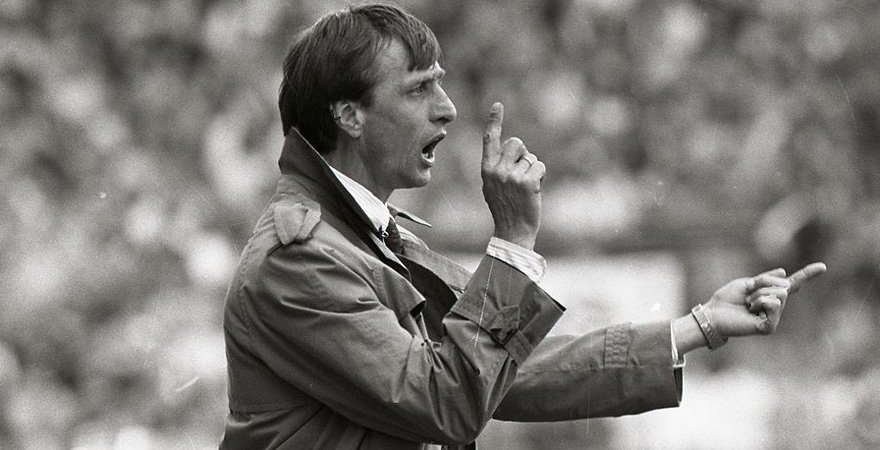
Cruijff’s Leadership Lessons: Proven Wisdom Through the Years
What I found interesting as a reader of those books then, and still do now, is that many of Johan Cruijff’s leadership principles that Winsemius wrote about have stood the test of time and were later often scientifically proven as the most effective leadership methods, such as in our HPO research that we first published in 2008. The examples and names in the book are outdated now; but many of Cruijff’s visionary ideas are now commonplace both on the football field and in organizations. It seemed fun to take another good look at the old article. These Cruijff principles have remained rock-solid:
- Team Over Individual: Cruijff’s Vision on Servant Leadership
Cruijff only fielded people who put all their talent into making the team they work in better. In Cruijff’s vision, everyone uses their talents to perform their core tasks as well as possible. This builds mutual trust. A team with a lot of mutual trust dares more and achieves ultimately greater performances. A field full of superior individuals can never compete with that.
- Back to Basics: Cruijff’s Recipe for Success
Cruijff always sought the simplest methods to achieve his goals and ensure that everyone knew his expectations. After making a simple plan, the focus then shifts to perfecting the execution: increasing the speed of action, preventing mistakes, and knowing when team members needed support from each other: “I have a terrible dislike for someone who moves, but does not know where he is going.”

He says: “I knew at a fairly young age what my qualities as a footballer were. As a forward, I simply didn’t have enough technique. I had to rely more on my hard work and determination, running my guts out to win a ball back. Well, if I succeed, I feel like a king. I am happy to pass the ball to someone who can do something good with it. And if it leads to a goal, then I beam with joy. Because that is my achievement: I took the ball away. I am proud of the title ‘vacuum cleaner.’ Inferior? No way, quite the opposite. A cleaner is not inferior either, right?”
- Always Sharp: Cruijff’s Strategy of Constructive Dissatisfaction
Both a team and a management team go wrong if everyone is satisfied. Cruijff constantly irritated his forward Stoichkov at Barcelona, so he was always on edge. According to Cruijff, stars also need to be challenged, through an unexpected substitution or criticism from colleagues. You must be willing to reward good people well, says Cruijff: “Cheap coaches are the first to be fired. If you are not expensive, people also do not trust you. Good people need to be challenged and well paid. The biggest problem is the salaries of the mediocre people.”
- Cruijff’s View on Leadership: Direct and Effective
Cruijff emphasized the importance of clear and direct leadership at the top. He believed that quick decision-making is essential and that leaders must remain credible and respectful. His approach to executives was just as direct; he kept them away from day-to-day operations so that the focus could remain on sporting and operational success: “Executives don’t become executives because they love football, they become executives because they love themselves. These people are also not there when your company is losing” and “A coach always maintains his independence. Your vision must be sacred, you must not be influenced by incidents or external opinions.”
A Timeless Vision on Leadership
In a rapidly changing world, Cruijff’s approach proves to be surprisingly visionary and timeless. Leaders and managers can learn a lot from the sports legend, whose principles continue to inspire.