Masterclass Inclusive Leadership

Masterclass Inclusive Leadership

Becoming a good HPO-manager for all your staff

In this interactive training, managers explore the “two legs” of their leadership and reflect on ways to elevate their leadership to the next level. Scientific insights from High Performance Organizations (HPO) and neuroscience are combined with practical examples, challenging cases, and exercises. The result? Participants gain a deeper understanding of their leadership style and leave with concrete ideas and actions to enhance safety, inclusion, diversity, AND results within their team.


Length: 3 hours

Program – Key Topics:

  1. The leader as a tightrope dancer
  • What makes leadership particularly challenging today?
  • The four most important predictors of effective leadership.
  • Self-reflection: what are your strengths as a leader, and where are your growth opportunities?


  1. The two legs of strong leadership
  • Daring and caring: why do you need both?
  • What is your strongest leadership leg?
  • Inspiring examples and compelling research.


  1. Diversity and inclusion: essential for leaders and long lasting results
  • Why diversity makes teams stronger, even when it doesn’t always feel that way.
  • The diversity paradox: opportunities and pitfalls.
  • The role of unconscious biases, privileges, and group dynamics.


  1. The power of an inclusive team
  • How does inclusion contribute to better performance and greater happiness at work?
  • How inclusion helps attract and retain diverse talent.
  • The devastating impact of exclusion: examples and statistics.
  • Micro-aggressions and micro-inclusions: recognizing, addressing, and shifting behaviors.
  • Making safety and unwanted behavior discussable within your team.


  1. Collaboration in diverse teams
  • How do people from different backgrounds build strong teams?
  • Cultural differences and the power of connection.


  1. Leadership awareness and action plan
  • The four stages of leadership awareness: where do you stand?
  • Reflecting on your own cases and challenges.
  • Practical tips with significant impact: what can you start doing today?
  • Future goals: where do you want to be in six months, and what support do you need?


Trainer: Esther Mollema


Target audience

This masterclass fits those who want to learn more about inclusive HPO leadership, including managers, team leaders, HR, managers training programs and executives.

Please contact Robert Smit for more information

Tailor-made

Together with our customers, we create bespoke training courses that support the learning goals of your team and/or organisation. Customisation is what we do by designing and organising programs that are 100% in line with the wishes and objectives of our customers. We help you and your team or organisation to gain more insight and to translate that into a better result. We like to think along with you, design interventions and help you achieve the desired result.

Turbulent Times in the Netherlands: The Importance of Patient Transformations

Turbulent Times in the Netherlands: The Importance of Patient Transformations


It’s restless in Dutch society and within many organizations; both are facing significant challenges. These challenges call for leaders who are not only decisive but also capable of empathizing with the interests of citizens and employees and connecting with them.

In this article, Esther critically examines how political and organizational leaders often opt for swift decision-making. They often label this as “high-performance” leadership because it appears action-oriented and decisive, but this approach is not the magical formula that will elevate our country or organizations to a high-performance level. If residents and employees do not recognize themselves in the measures, trust and support are lacking, and goals and solutions remain out of reach. A strong plea is made for a long-term vision and an empathetic form of leadership on the road to sustainable success, with the HPO framework providing guidance.

As a strategic advisor and trainer, I’ve noticed that nearly every organization is currently facing significant challenges. These challenges are diverse: digital transformations, staff shortages, climate-related issues, energy transitions, improving efficiency, financial matters, integration of business units, increasing distrust from stakeholders, and the adoption of hybrid forms of collaboration. All these matters require a thoughtful approach.

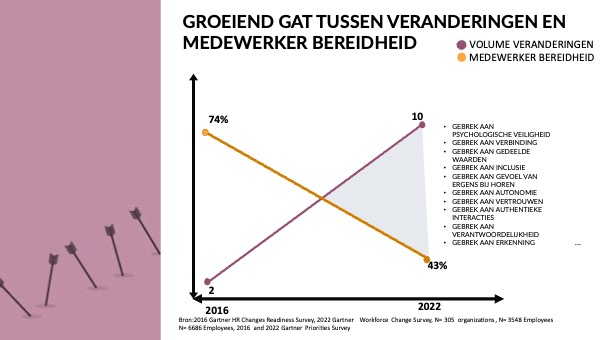
Research from Gartner shows that in 2016, organizations on average implemented two organization-wide transformations. By 2022, this number had risen to ten on average, putting considerable pressure on organizations. Leaders must react quickly and execute effectively while also keeping their organizations flexible and resilient to continuously innovate and transform as a whole.

Connect, Develop, and Engage
The pace of transformation seems to struggle to align with employees who desire more psychological safety, deeper connections, authentic interactions, and recognition. Research from The Workforce Institute indicates that nine out of ten leaders in organizations believe that their organization provides all of this, positively influencing the mental health of their employees. However, 70% of employees in those same organizations state that the organization and their immediate supervisor have a greater negative impact on their mental health than their life partner. They long for work environments where organizations and their leaders actively contribute to their personal growth and harness their full potential. It’s an important signal: employees want more recognition and to be taken seriously and are not necessarily willing to go along with all changes automatically. They want a voice in those changes and attention to their personal interests.


Image: Gartner Research on the Growing Gap Between Necessary Changes and Employee Engagement. Esther argues in the article that the same challenge applies in our society.


The Dual Challenge
The challenge is not to lose sight of humanity at the necessary speed, and even stronger: to actively involve them in shaping solutions and keeping them engaged in the process. Many changes and transformations can only succeed if all employees are fully committed; they must become active participants in the solution. Without this, they will not easily join the desired movement (or may even actively oppose it). This phenomenon manifests itself in almost every organization I encounter. Leaders fail to effectively communicate the message of necessity and miss the trust and full commitment of the employees who must implement the transformations. It can paralyze organizations, and leaders sometimes seem to be backed into a corner.


Similar Challenges in Dutch Society
This situation also appears to occur in our society as a whole. The Netherlands faces enormous challenges in climate, trust, aging, income inequality, and essential services. There is an urgent need for concrete steps to create a sustainable future together. The recent elections have made it clear that many people feel unheard and have little confidence in the current leaders and the existing (democratic) system. In their call for recognition, many voters have made more extreme choices, sometimes impulsively. They want to be taken seriously and demand solutions to problems that have remained unresolved for years, such as the childcare benefits scandal, gas extraction in Groningen, housing shortages, and the nitrogen dossier. The credibility of and trust in Dutch political leaders to solve these issues promptly has steadily declined, and it seems like a long road to restoring this trust.


The Gap Between Decision-Making and Interests

The recent elections reflect the societal unrest that I often encounter at the organizational level as well. Both citizens and employees of organizations crave more attention, recognition, and customization. They want to be taken seriously and involved in finding solutions that affect their interests, well-being, and work.

In their haste to address the many challenges, leaders often make hasty decisions that may seem beneficial in the short term but have harmful long-term consequences. In politics, a possible example is Kuiper’s decision to consolidate heart surgery. Concerned hospitals want more collaboration to prevent closure and appealed to the judge, who ruled that it is unclear whether this decision is necessary and proportionate. But also, the importance of short-term gas extraction the happiness of the people of Groningen, and the desire to combat fraud that led to the childcare benefits scandal are examples.

In organizations, I often encounter examples such as:

  • Implementing efficiency improvements without consultation, leads to sudden restructuring, resulting in disrupted work relationships and feelings of not being taken seriously by employees.
  • To address staff shortages, international recruitment was utilized. The team unexpectedly gained English-speaking colleagues, meaning they now had to communicate in English at work without prior discussion. This led to misunderstanding, and the team felt overwhelmed and not taken seriously.
  • The introduction of new production lines without prior discussion about future retraining and career development of existing employees, who feel discarded after years of loyal service.


Do you recognize similar situations in your organization?


High Performance Requires Challenge and Human-Centeredness

What then is the right approach?

To understand what often goes wrong and how leaders can bridge the gap between organizational goals and employee engagement, we can learn from highly successful organizations. The HPO Center, where I am part of the expert team, has been studying organizations that have outperformed their competitors strategically and financially for five to ten years since 2007. This research identified five pillars crucial to their success: quality of management and employees, continuous improvement and innovation, long-term vision coupled with short-term action, and focus on stakeholders such as customers, employees, financiers, and suppliers.

What often goes wrong is that leaders use the term ‘high performance’ to enforce results through short-term actions. They define high performance in terms of speed, exerting pressure, and maximizing profit. However, this is not the right approach to achieve sustainable success in the long term. In excellent organizations, leaders combine short-term actions with a long-term vision and involve their employees in it. They are responsible for both the results and the well-being of their people. The quality of their leadership is characterized by a healthy balance between ‘caring’ and ‘daring’: they set clear goals, delegate responsibilities, and focus on results, but they also inspire, involve, and coach their employees. If you want to know more, read the article on the Two Legs of Good Leadership: https://www.esthermollema.nl/twee-benen-van-goed-leiderschap).


Investing in Employees is Crucial
The conclusion is clear: implementing and succeeding in transformations requires leaders and teams who pay attention to each other and each other’s interests, inspire each other, and develop and grow together. This generates energy at the human and organizational level, and therefore, effectiveness. If you don’t do this, employees will resist or disengage, with serious long-term consequences.

Investing in employees is crucial: listening to their perspectives and interests, providing customization, and building trust before trust is lost. Although this may not result in quick transformations immediately, it will be the key to successfully implementing transformations in the long term without having to initiate new transformations constantly.

I wish our society and organizations human-centered leaders who have the courage to lead not only in the short term but also in the long term, inspiring and guiding. Major transformations need to be approached with patience and attention so that people can and want to take the next steps with confidence in a constantly changing and uncertain world.


Custom designs training courses

Custom designs training courses

Customisation

Together with our customers, we create customised training courses that support the learning goals of your team and/or organisation. Customisation is what we love. We design and organise tailor-made programs that are 100% in line with the wishes and objectives of our customers. We help you and your team or organisation to gain insight and translate that into results. We like to think along with you, design interventions and help you achieve the desired result.

Recent custom orders

Below we describe a few recent examples.

Diversity Training

Client: Handelsbanken.
Handelsbanken has equality as one of its main values and trains all managers on this subject. For the Netherlands, Esther adapted the Swedish training and worked on the themes of Diversity, Inclusion and Equality during a three training day with six men and women from Handelsbanken. Alies Pegtel and Julia Wouters were responsible for parts of the training.

Unconcious Bias in Mentoring

Client: Philips.
For Philips Worldwide Mentoring program, Esther provides a tailor-made online training on unconscious bias in mentoring programs. With a handy checklist for mentors and mentees.

Diversity & Inclusion Commitment

Client: Dutch Ministry of Economic Affairs.
How to ensure that you do not lose sight of the subject of Diversity in times of Corona? During an online program with a board of EZK, Esther worked with them on formulating measures that promote diversity and inclusion.

Writing inclusive vacancy texts

Client: ABN Amro.
For this assignment, we enlisted the help of Jantien van Driel – with whom Esther provided the latest edition of the booklet Inclusive Recruiting, Selecting and Writing. Jantien has created a guide for writing inclusive vacancy texts for ABN Amro and is advising this client.

Workshop Unconscious Bias

Workshop Unconscious Bias

In-company workshop on Unconscious Bias

What does an in-company workshop on Unconscious Bias or unconscious prejudices yield?

  • Understanding: The participant is aware of how the paradox of diversity and inclusion works and how it greatly affects how we act and decide every day.
  • Experiencing: the participant experiences, based on short exercises, how your brain chooses and acts, different from what you might think in advance.
  • Review: after the workshop, the participant can more easily recognise situations in which unconscious prejudices can play a role in themselves and others and can name them.
  • Apply: the participant can take measures to reduce bias and increase inclusion. Depending on the purpose of the workshop, the training sessions last between 3-8 hours.

Click here to see a snippet of what an online training could look like.

Program

A possible setup of the in-company program about unconscious bias:

  • How do unconscious biases affect the decisions we make? How big is that influence in your life and work? In this joyful part, participants undergo small experiments to experience bias in their brain. We use film and exercises.
    Background for this part: by experiencing unconscious bias yourself, you learn to accept. By keeping it light, your brain is more open to new insights.
  • What is the result of bias in our work and life? What are the effects of bias in our organisation and activities? Why is bias such a big problem in the Netherlands – greater than in many other countries? Based on examples, we see that bias unconsciously gives some people a better chance and others less.
    Background for this part: understanding and stimulating (self) research into how bias works and how many small, often insignificant activities attract or exclude some people more than others.
  • How to achieve more diversity together? What you can do to prevent bias, and how you can judge and decide more objectively.
  • What is inclusion, and why is inclusion preconditional for more diversity? We discuss the unwritten rules of collaboration, labeling and how inner groups form. How does inclusion affect people’s well-being? Together with the people sitting next to you, you will investigate whether the organisation is inclusive enough to embrace more diversity.
    Background of this section: realising how inclusion and exclusion work and how a sense of belonging affects your commitment to your work and the way you can excel in your work.
  • We give you nine easy ways to work on more inclusion. We ask the individual participants what they will to tackle as of today.
    Background to this part: get started! We go from talking to doing. We make the changes in your behaviour so small that you can work with them.
  • What can and will you contribute? We discuss the Become More Inclusive in 30 Seconds A Day Challenge. Will you join? What do you intend to do?

Reference

“We have had a very good session!” Positive feedback from all participants. A very big compliment for the energy and passion which she brings, even by using Teams. “It was as if she was standing right in front of me” is what a participant mentioned to me.”

Marco Fritz, General Manager Europe, Chamberlain Group

Target audience

Each training is adapted to the level of the participants. We ensure that the examples we use fit the target group.

Direction Mindbugs Test

We recommend combining this workshop with the Direction Mindbugstest. This charts the bias of the participants. There are three different tests to choose from. It is a good way to get close to the subject and increases the self-knowledge of the participants. The test serves as an example to show how bias works in the individual participants. We ask the participants to complete a Direction Mindbug test online in advance. This test takes 2×8 minutes to complete.

Generational Differences in Organizations: How Generation Z asks for what we all truly want

Generational Differences in Organizations: How Generation Z asks for what we all truly want

My own first work experiences and what I (didn’t) do

I remember well that at the beginning of my career, I accepted a job that was quite disappointing. The work was dull, the guidance was lacking, and I found my boss a bit unpleasant. I tried for a while, but one day, during a visit to my parents, I let slip that I actually wanted to quit. My father immediately responded, “Whoever convinced you that work should be fun? You can’t just give up. You have fixed expenses, a resume with little work experience, and a gap in your CV can work against you. Working somewhere for less than two years raises questions, and you want to avoid that.”

And what did I do? I returned to that dull job and that unpleasant boss. I did what my father said I should do, but it came at the cost of my mental health, my sleep, and certainly my joy of life. Looking back now, I regret not being a little braver and doing something else a bit earlier.

The challenging relationship between Generation Z employees and their leaders

The Generation Z employee is a topic of discussion for many of my clients. Many managers find this new group of colleagues difficult to motivate. This generation values their personal lives, seeks a sense of belonging in the workplace, and wants to be able to be themselves. They ask questions and demand honest, meaningful conversations, more learning experiences, faster career progression, and action-oriented feedback.

How different the reality is in the job market for a starting Generation Z employee compared to their leaders when they started working. The latter could rent a house with their first salary at the time, whereas Generation Z considers owning a home as utopian and often continues to rent a room, with or without friends. Owning a car has become less common, there is doubt whether this is still a world in which you want to raise children, and whether there will even be a pension by the time they reach their seventieth year. Uncertainty reigns.

Motivation experts emphasize that motivation stems from pursuing achievable goals that genuinely interest and satisfy you. The absence of these small motivational boosts results in many in the new generation being less inclined to fully dedicate themselves to their work and to easily forgive the mistakes of leaders in exchange for career opportunities.

What Generation Z wants

Generation Z strives for engaging work and inspiring leaders. They are young people who ask critical questions, long for meaningful conversations, mental well-being, career advancement, and constructive feedback. In other words, they seek purpose, growth, and a sense of connection.

Research from the Workforce Institute shows that the percentage of employees willing to give up a well-paid position for a job with better mental health is increasing. This poses significant challenges for current leaders.

For organizations that want to remain attractive to employees of all generations, there are some valuable considerations:

1 Trust your employees before they trust you Give employees the flexibility and autonomy they need to do their work well and have a good life. People looking for other jobs closely scrutinize vacancies for flexible work arrangements. This is decisive for whether or not they respond to vacancies. If it’s unclear how flexible the work environment is, they won’t respond. Of course, this comes with trust and requires responsibility from both sides. You can, of course, hold your employees accountable if the given trust is breached, but above all, give it first.

2 Engage in more authentic interactions Make time to really get to know each other in your team and make people feel truly at home. Honest, vulnerable conversations, especially with leaders, bring the psychological safety that employees and teams need; it makes teams stronger and helps them perform even better together. I meet many leaders who think that taking time for vulnerable conversations isn’t worth it or that such conversations don’t belong in the workplace. A lot of research (and especially the response from Generation Z) shows that these leaders are really mistaken.

3 Invest in career development with frequent, concrete feedback Get rid of vague, unusable feedback; employees want clear, practical suggestions for improvement. In many organizations, there are still too many ritualistic, obligatory, annual battles over evaluations, salaries, and promotion opportunities. But employees just want much more frequent, shorter conversations about their careers, their milestones, and next challenges. They want feedback, to hear what’s good and what can be improved. And then, please, make it concrete enough for them to act on immediately. Stop with feedback like “I’m not exactly sure why, but if your leader says my feeling is that you’re not ready yet.” (This is really a real-life example!) Make sure there’s weekly contact with new employees about their progress and how they’re feeling in the team, and after a while, decide together how often those short conversations are needed. Never delay giving compliments; all people are sensitive to them.

4 Give teams space to adjust unworkable rules Give your team autonomy to adjust rules that don’t work. In their quest for overview, predictability, and control, organizations have often devised various rules that work for the majority of teams but not for some teams at all. Or rules that once worked but now mostly work against. Give teams the space to adjust such rules. Of course, this is done in consultation with leadership because giving space also comes with responsibility for the team wanting to abolish the rule. The ultimate goal must, of course, still be achieved.

5 Introduce diversity into the team to promote productive conflict and growth Productive conflict, yes: different perspectives enrich the team and stimulate innovation and improvement. Teams become more attractive when people can challenge each other through productive conflict. This means that team members can contribute from their expertise, life experiences, education, and thinking styles to the plans and to a better team result. Team members benefit from each other and each other’s different knowledge and insight, regularly seek each other out, and make each other better. Teams that want this don’t look for new team members who fit perfectly into the team but for people who can bring something different and therefore extra. These teams also make more effort to integrate the new team member into the team as quickly as possible and make them feel at home instead of asking the newcomer to adapt as quickly as possible.

Generation Z asks for what we all actually want

Many leaders say they find Generation Z difficult. It confronts them with the fact that things can also be different with better results. Generation Z is the generation that takes the lead in making organizations the place where we are all inspired and challenged. Where we can all contribute to something greater than ourselves. Let’s face it: that’s what we all actually want, isn’t it? Leaders who realize this and work on it are the leaders of the future.