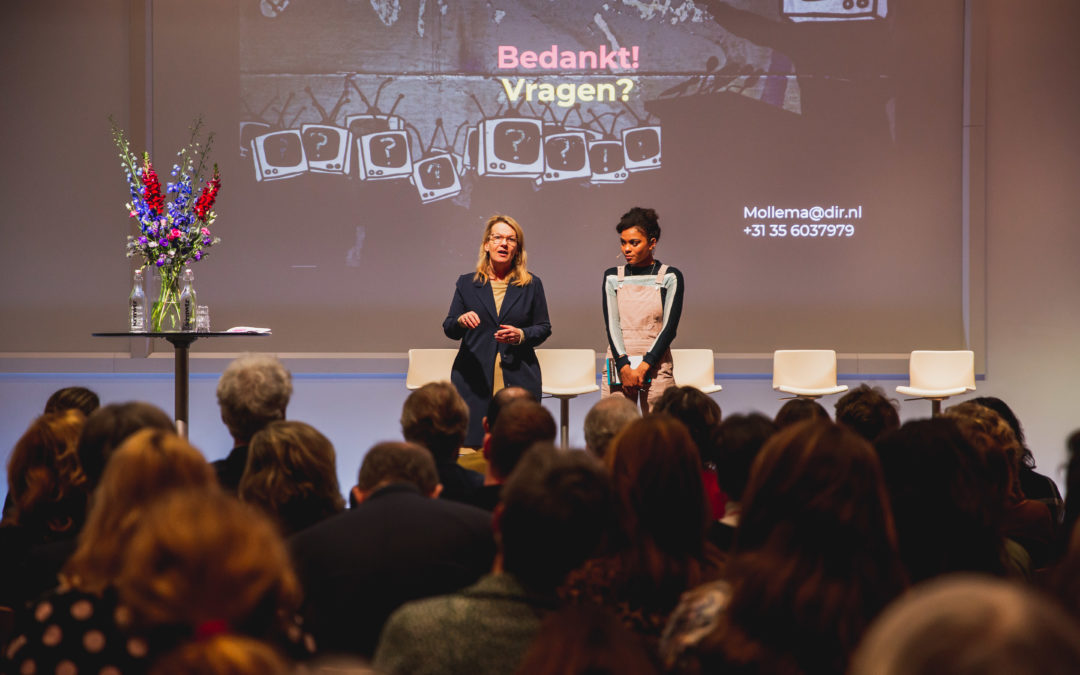
Esther Mollema interviews Anna Fels

Esther Mollema interviews Anna Fels

During a visit to New York, Esther Mollema interviews Anna Fels, author of the book Women and Ambition.

Let’s talk.. about ambition

Many women seem to have a difficult relationship with ambition. They are ambitious, but they often don’t say it (enough). Esther talked about this with Anne Fels ( American ) who did research on this topic. Anna Fels en Esther Mollema At the end of your performance interview, your boss asks about your ambitions for the following years. What are you doing? Do you immediately come to the point with a concrete proposal, such as: “I would like to grow into a senior position in two years’ time and lead my own team”? Or do you say, “I don’t really know. I want to grow in content and develop myself personally, but I don’t know how exactly. ” Are you asking for a deserved promotion? Or are you waiting for your boss to offer it?

In my experience (Esther ed.) many women still find it difficult to indicate clearly what they want. And that’s why I got on a plane to New York to speak to Anna Fels, who gave so many insights about this in her book “Women and Ambition“. She conducted a major research into dreams and ambitions, and what they mean to us.

The many women she interviewed for her book all spoke fluently and candidly on everything from money to sex. But when it came to their ambitions, it suddenly became difficult! And yet ambitions fulfill a deep human need. Whether teaching, healing patients or a career in business: being good at something and getting recognition for it is essential to our well-being and happiness. For women of today, the road to something good is wide open. We have access to all courses and professions. However, the pitfall is still in recognition, says Anna Fels: “that is still more difficult for women than for men.”

Anna Fels,if ambition is so good for us, why is it often such a difficult subject for women?

“Women’s roles are changing at an unprecedented rate, probably more than ever in history. Cultural values ​​that were valid for centuries are broken. But those values ​​still have an impact. In the past, women often had to subordinate themselves to others. There was little room for themselves. That is still the case with many women.

Many women feel guilty if they want to do something for themselves, for example promote while they already have a nice job, or if they want to work more hours. Wanting to make a career, being ambitious, is then considered to be very selfish. Women often hide their ambitions. I even see here in New York, the epicenter of ambition, few women who are truly openly ambitious.

Women who are successful often say that it just happened that way and that they were very lucky. ” Despite all the changes in recent decades, it has proved difficult for women to maintain their ambitions, says Anna Fels. Because we still expect women, whatever their dreams, to be primarily caring and supportive to others. So a tricky pitfall…

Following your dreams and ambitions makes you happier, but “real women” and “good mothers” should (we still think) not choose for themselves. Of course that is changing, but in almost all women today you can still see some of this internal struggle.

Anna Fels, what can women do themselves to stick to their ambitions?

“Everyone needs encouragement and attention for his or her ambitions to be motivated and productive. I often see women who do not receive this encouragement in my practice. I show them that they are in an environment where they receive very little support. That they must stop trying to change themselves and that breaking them is not personal failure, but simply the best, inevitable choice.

The solution is not to stay where you are, but to find a new job, a new environment, a new mentor. Cut your losses and get out! My second most important advice is that in such a situation you should not so much look for a new job, but especially for a new boss. Someone who does give you support and recognition. Also look at the people who already work for this person. Is that the environment in which you fit and will flourish?

I hope that women will support each other much more in the coming years by letting each other know for whom you should and should not work in an organization. I hope there will be more networks in which women discuss this with each other.

Anna Fels: “For men a lot is changing too”

In my work I see that more and more men are starting to make new and different choices. How do you also recognize that?

“For men, this major cultural change is also getting more exciting. Until now they have had much clarity. Men did not receive negative feedback in their choices, for example to make their careers more important than their families. But a lot is changing for them too: 35 percent of women in the US are already earning more than their husbands. And in the last recession, especially men have lost their jobs. Those families already live in a new truth. ”

In the Netherlands, I (Esther ed.) advise many companies that want to prepare their women and men for a more diverse composition of their organization. How well does that work in the US?

“We have known for some time that organizations with a good male / female ratio perform better, but it develops still slowly. A bright spot is that it is a real culture revolution and if you look at it that way, it all goes quite fast. But if you experience it yourself, you can be annoyed by that slowness, yes.”

As a mother, what can you do to prepare your daughters for these new choices and lives?

“Parents who want to help their daughters to choose new, less traditional roles should especially teach children how to become good at something. Children like to feel special and special, to be proud of themselves. It doesn’t really matter what, but they have to feel that they excel at something. And for recognition, the compliments of just your parents are not good enough.

Children quickly realize that parents are not really objective. They must get the signal from the outside world that they are good. Parents can of course organize this carefully. By looking for their talent with their children and then ensuring that they receive compliments from others. ”

Esther Mollema’s books can be ordered via bol.com

‘Women also want male leaders’

‘Women also want male leaders’

Esther Mollema about unconscious mechanisms in organisations

Women outperform men and are equally ambitious. Yet they are outnumbered in top positions. Trainer Esther Mollema blames that on mindbugs: unconscious prejudices that have been fed with men and women. In organizations she brings those mindbugs to light.

The Dutch think they don’t make a difference between men and women, but they do in practice, ”says Esther Mollema (52). “In organizations, they are convinced that they choose the best leaders, but in reality unconscious prejudices play an important role.”

Unconscious bias

For eighteen years now, Mollema has been working to make organizations and their leaders more aware of these mindbugs. That is quite a job. Esther Mollema about unconscious prejudices in organizations:

“The Dutch have no more unconscious prejudices than people in other countries, but we do think much rosier about ourselves. That makes it extra difficult to face our mindbugs. We make a lot of decisions every day, so we can’t all think about that consciously. As a result, we make the majority of our decisions unconsciously. In doing so, we fall back on what we have learned about this – often stereotype – ideas in our upbringing.

”For example, 95 percent of Dutch managers initially indicate that they find women and men to be equally competent. But a mindbug test among over 11,000 of them shows that 83 percent have an unconscious preference for a man as a leader: 87 percent of men and 80 percent of women. No wonder so few women reach the top of Dutch business: only 6 percent of the directors and a quarter of the supervisory directors of listed companies are women, according to the latest Female Board Index.

“With characteristics such as taking initiative or a focus on results, men and women still think more of a man than of a woman,” Mollema explains. “But that is completely unjustified. A large international survey shows that employees rate their female executives even better than men for these traits. The explanation is that women often feel that they are the underdog and therefore do their utmost to be accepted. That currently makes women better managers than men, although they are not genetically different.”

Less intelligent

About five years ago, Mollema was invited by a Protestant organization (she can no longer figure out which, FP) that wanted to examine their unconscious prejudices. “I asked them to talk about their mindbugs in small groups, but no one dared to speak up. I then spontaneously suggested that they all write their views anonymously on a note. I then read it to the entire group. This resulted in extreme statements, such as: “Women are less intelligent,” “Because of their periods, women cannot hold leadership positions,” and “It is not God’s intention for women to lead.” The women and some of the men in the party were shocked. A conversation about that was hardly possible.”

Ambitious women also encounter other obstacles in organizations, Mollema says. “They often do not know about the unwritten rules, because they do not belong to the inner group with whom these rules are shared. This group usually consists of people who look like the managers; in an organization with male leaders, these are usually men. They tell each other who you should be with to get something done and who you should definitely not kick. Because women often do not belong to the inner group, they also earn less than men with the same work, because they do not know what to negotiate – for example about allowances. And they think that their manager wants the best for them, but often he wants the best for himself.

A good manager helps you take the next step in your career, so I advise women: choose a good boss and not a job. Women have learned in their education to do an excellent job. Then they think they will get the promotion they deserve, but that doesn’t work in masculine organizations. There you have to ask for the next step in your career. ”

Divers

Mollema strongly supports more diversity in (the top) organizations. “Research shows that various teams are more successful and achieve better results than homogeneous groups. That’s because there are more different opinions in mixed teams. That makes decisions richer and better. Provided that the manager can properly manage it.”

But how do you get those diverse teams off the ground? “You can’t prevent mind bugs,” Mollema says matter-of-factly. “They arise between what we see around us between our zero and third year. But you can remove prejudices from the process of the organization by observing exactly where things go wrong. Then it turns out, for example, that during job interviews on the spot questions are made up.

This encourages the confirmation of prejudices. It is better to complete an agreed questionnaire. Each member of the application committee gives a score after each question, which is later compared to that of the other members. It is best for them to speak individually with the candidates for a position, as they are least affected by the other committee members. It is also important that vacancy texts are free of language that particularly appeals to men and deter women. “You are decisive,” for example, boils down to “You help your team and monitor progress.” The first formulation is more popular with men, with the second you reach both men and women. Explain to candidates how the application process works, because women often drop out when they have to do an assessment unexpectedly, for example. Explain new employees to negotiate. And justify why you give an employee a certain assessment after communicating with your colleague managers before communicating that with the employee. Others can then give you feedback on your mindbugs. You judge people who look like you statistically too high, people who are different from you too low. ” Mollema also has a tip for ambitious women themselves. “Work abroad for a number of years early in your career. I notice that women with experience in another country reach the top faster, because they have been given opportunities that are still lacking in the Netherlands. ”

Discipline

According to Mollema, the introduction of measures for greater diversity requires a discipline that we often do not have in the Netherlands. “When organizations promise to improve their lives, they forget it two weeks later. That makes it extra difficult to change the balance of power in the Netherlands. You are not there yet with awareness of your prejudices. The relationships will only change if companies link agreements to them, which they also adhere to. There are organizations where, with my help, it works, such as ABN Amro. There, the percentage of women in top positions rose from 23 to 40 percent in two years. ”

According to Mollema, it is no more difficult to get top men in motion for this than top women. “Only very masculine men still refuse to commit themselves to more women in top positions because they are afraid of their own career. I see the group of men who support diversity in their company grow larger – but that can also be wishful thinking.

Hard work

There are many conscious and unconscious prejudices about differences between men and women in the workplace. Mollema puts some of these ideas into perspective. Women have less ambition than men.

“That statement is not correct. The Dutch are less ambitious than workers in other countries, but there is no difference between men and women. Often “saying you’re ambitious” is confused with “being ambitious”. Women demonstrate their ambition by working hard and trying to make their dreams come true. ”

Women profile themselves less than men.

“It is true that women find it difficult because they have not learned it. On the other hand: in high-performing organizations you do not have to profile yourself as that is where your actions count more than your drive to profile. I like that better. In any case, it is important to take your chance if you are asked to speak to the management or give your opinion on TV. Women are quick to take refuge because they are expired by such a question, but they are short changing themselves.”

“Women are more critical of themselves than men. “When a woman is turned down for a job, she thinks I’m not good enough. A man blames the application committee. But let’s say that being critical is a very good quality. I wish leaders were a bit more critical. ”

Women are less able to negotiate than men.

“Not true. They are less able to negotiate for themselves, but they are good at doing so for the organization. When it comes to themselves, they feel they should get what belongs to them, without having to ask. But that’s not how it works in most organizations right now. Negotiating is not necessary in a transparent and fair system. Women and organizations must grow together in this. ”

Women are less able to network than men. Esther Mollema about unconscious prejudices in organizations.

“That is right. Men see that more as a necessary evil to progress. Women do not always understand its usefulness; through their upbringing they trust that their qualities will bring them further by themselves. But you really need to know the right people if you want to achieve your goals. If you keep an eye on why you have chosen a certain position, networking becomes less difficult, because then you know what you are doing it for. When I think: this person can help me further on my career ladder, I dare not speak to him, but when I think: he can help me with my goal to make mindbugs visible in the Netherlands, I just do it.”

Women give more priority to their private lives than men.

“The Dutch spend more time on their private lives than people in other countries; we ourselves make a distinction between men and women. When a man says he works 60 hours a week, I ask: Every week? And until what time do you work on Friday? Then the 60 hours often turns out to be a bit exaggerated. Women with full-time jobs only work a few minutes less than men who work full-time. For women it is difficult that they have to show their most ambitious side during the period that they have children. I advise women not to make any big decisions in the field of work. In those years they think that their ambition is diminishing, but it usually comes back quickly. ”

Women consider supplying good products more important than bringing in as much money as possible.

“That’s right. Women are more driven by ideals. Men sometimes see earning a lot of money as a means to make something happen in their private lives: buy a boat, get more freedom. Incidentally, I meet more and more male leaders who also base the way they work on their ideals.”

Source: Volzin, November 2017
Text: Frieda Pruim

International Women’s Day revisted: Get to know your own mindbugs

International Women’s Day revisted: Get to know your own mindbugs

“Get to know your own mindbugs” lecture by Esther Mollema on International Women’s Day

“Why do hurricanes with a woman’s name lead to significantly more deaths than hurricanes with a man’s name?” asks lecturer Esther Mollema.

Workshop-Mindbugs

The answer: because we consider Bonnie, Emily and Fiona to be less threatening than Alex or Karl and therefore take fewer precautions. The above is not a joke, but a scientifically proven example of a mindbug: a wrong assumption that both men and women have when it comes to competencies and attributes that we attribute to each other.

Mollema is one of the speakers at the celebration of International Women’s Day with about forty school leaders and school administrators. She lightly confronts her audience with a number of painful mind bugs: prejudices, stereotypes, behavior that does not fit our beliefs. These mind bugs contribute to the fact that the number of women in leadership positions does not reflect the workplace at all. That is certainly a problem in primary education, because with this we teach children in a crucial development phase exactly the same mind bugs. And we are barely aware of it.

‘That uncertainty is not necessary for anything’

The fact that the Netherlands is one of the most emancipated countries on paper does not mean that women actually get the same opportunities, says Minister Jet Bussemaker, who took the trouble to come to Utrecht in between radio, television and political performances. ,, Women actually judge a CV better when it is from a man, than when it is exactly the same CV from a woman. We have every reason to worry about that. “”

Read the whole article on the website of the ‘PO Raad using this link ( in Dutch )!

More diversity? Recognize your own mindbugs!

More diversity? Recognize your own mindbugs!

Mindbugs, we have them all. Men are better leaders. Someone who does not speak perfect Dutch is not knowledgeable. People older than 55 people are exhausted and inflexible.
Even though you may not think so, we all make assumptions, often unconsciously. And so without even thinking about it. These mindbugs, as they are called in science, have a major impact on diversity in the workplace, says researcher Esther Mollema.

Words, not actions

Equality for all is a great asset in our country, our research shows. We believe that men and women are equally capable of holding leadership positions. And we are almost all in favor of more diversity in the workplace. Yet we do not yet know how to turn words into action. How did that happen? In her book “Success in multiplicity” Esther Mollema tries to answer that question.

Equality is the crux

With her company Direction, Esther interviewed more than eleven thousand managers on the subject of diversity. According to her, the equality which we consider here as a fundamental right is precisely the issue. “Because many managers do not want to be bound by a diversity policy. If they have to hire other people to achieve more diversity, they see that as a step backwards. They just want the “best” candidate.”

Is it really the best candidate?

But how do you choose “the best” candidate? And is the best really the best? That’s just the question, Esther says. “We make a lot of decisions, perhaps 90 percent, unconsciously. Our brain makes a selection for us. That is nice, because one day you get so many stimuli and information that it would otherwise be very difficult to deal with this. But there is also a downside: we do not see the world as it really is and what actually happens, but only an interpretation of it. We depend on what our brain makes of it. ”

Nanosecond

These interpretations of our brain also bring with it unconscious prejudices, which can influence your behavior in a nanosecond. These prejudices, labeled by Mahzarin Banaji, professor of Social Ethics at Harvard, as “mindbugs” – are often based on a certain line of thought. Esther: “An example of a mindbug is that women with headscarves are less suitable as leaders. People who have this mindbug probably think that these women are forced by their partner or parents to wear a headscarf and are therefore submissive. ”

Mindbugs? Discuss them!

What can we do with this science now? “You can’t help that you have mindbugs. But how you act on it; you can influence that, “says Esther. “It is important to openly and honestly discuss mindbugs in a team and involve multiple people in reviews. In this way you make mindbugs transparent to each other and you learn to recognize them. This can ultimately contribute to a more diverse workforce. And that is all the more important for an organization like DNB that strives for High Performance (HPO), says Esther. “The more diverse a team, the more likely you are to make each other a little better every day because of your different backgrounds, visions and experiences.”


Read the Interview for the Dutch National Bank here ( in Dutch ) ‘More Diversity? Recognize your own Mindbugs!’ in PDF.

EXAMPLES OF MINDBUGS

One recognizable, the other less so: which mindbugs do you have? And where do they come from? Esther discusses three examples:

  1. Employees aged 55 and older are exhausted and inflexible “Twenty years ago, only a quarter of the over-55s worked. We let them out during reorganisations and in times of high unemployment. This has fueled the impression in some people that people over 55 no longer feel like it. “
  2. Someone who does not speak perfect Dutch cannot be an expert on a subject. “Our brain is very attentive to accent and way of talking. That affects the message and how seriously we take it. With someone with a dialect or foreign accent, we sometimes pay more attention to the pronunciation than the content of the message. “
  3. Men are better leaders. “A typical example of a mind bug that originated a long time ago, when we were still roaming the savannah in groups of 150 people. The strongest figure led the way and was in charge; that was a man at the time. “
Source: DNB Florijn #3 – September 2015
Author:
Marlieke van der Sijde