What my time in Japan taught me about same-race effect and how you prevent it

What my time in Japan taught me about same-race effect and how you prevent it

During my undergraduate studies, I was lucky enough to have an internship in Japan. It was an unforgettable time with many moving and special experiences. I went alone, didn’t speak a word of Japanese, lived with two Japanese students in a tiny house, got pushed into the subway every day with thousands of others, and worked at Japan’s largest company, NTT. Unfortunately, hardly anyone spoke any English at work that I understood anything about. Simple things turned into an adventure. I left Japan with a backpack full of admiration, respect and funny stories that I like to tell.

The Tall One and the Panda

Wat mijn tijd in Japan mij leerde over same-race effect en hoe jij het voorkomt

Farewell Party, NTT Japan (1986)

One thing I haven’t talked about before is that I had a lot of trouble distinguishing all the people and colleagues I dealt with every day. I still feel very uncomfortable about that. It was just as if they were just sitting at their desks. But when I met them in the hallway or at lunch, it was impossible for me to recognize who was who. I confused the top boss with the male secretary and it was an embarrassing situation. I was really ashamed. Every day the inconvenience started that I couldn’t tell my 15 closest colleagues apart. From misery I taught myself a kind of survival technique and came up with a defining characteristic for everyone in the department that I could use to tell them apart: my boss was Babyface, my supervisor De Lange, the department secretary the Panda, the man from the other department who always The Professor was so kind. I also remember the Comb, the Laugh, the Little and the Divorce.

Princess Diana

In the early days I could just hold my own with this method. If I look at the photo from a long time ago, I can no longer imagine that I could not distinguish them. How could I not have seen the differences then? They are really all very different. Their face shapes, their height, their hair. What was wrong with me? And yet I think my Japanese colleague had the same problem. They all said that I was a lot like Princess Diana, the then crown princess of the UK. One evening when a Canadian lady I met told me that everyone in her organization thought she looked so much like Princess Diana too, something dawned on me. What was going on?

Same-race effect in the brain

Later when I started to deal with unconscious prejudices, I learned that what I had experienced in Japan is not very special. It can be explained from how our brain works and how it makes unconscious choices. It works like this: our brain looks for ways to make quick decisions. What we see in particular is very decisive for making decisions quickly. The eye scans the environment and looks at other people to gauge it quickly. Reading faces in particular is a mechanism for quickly identifying danger from friendship. That was already the case when our distant ancestors lived in itinerant tribes on the savanna and that is no different now. Our brain focuses on being able to accurately read and distinguish faces at a very young age. Which emotion do I see? What does this person want? Can this person be trusted? We learn to read faces and especially the faces we often see. Your brain develops an increasingly refined ability to see nuances and emotions in those faces. We immediately see fear, joy or annoyance in the faces of the people we interact with a lot. And that specialization comes at the expense of faces we don’t often see, for example someone with a different skin color. Actually, our brain does not know how to read those other faces and it is difficult to distinguish. All those faces look the same to your brain. And that was what I experienced in Japan. That’s why I struggled so much. In science, this phenomenon has been described as the same-race effect.

Large consequences

Stanford professor Jennifer Eberhardt also writes about this in a very educational book called Bias, the new Science of Race and Inequality (2019). She expertly shows how this same-race effect in your brain has major consequences in our actions today in organizations and in our society. This effect and not being able to distinguish well with people with other facial features, such as skin color, often leads to generalization of the group that you do not know well. You find them all similar and you give them all the same characteristics. Often negative features. Because you cannot properly estimate this group, you approach this group with a bit more distrust. This is also an unconscious automaticity of your brain. As a result, you can easily see the entire group as a category to which you assign many of the same properties. This is how unconscious prejudices form in your actions. And with unpleasant unconscious consequences. Also just in the Netherlands. Did you know that in the Netherlands today a white person with a criminal record is more likely to be invited for an interview than a black person who has never been in contact with the police (UvA, 2017)? Many people with a migration background still indicate that when they sit next to a woman in the tram, she often holds her bag a bit tighter. Unknown makes unloved in the brain. With major consequences.

Hold the thief!

It happens to everyone. Also Neil deGrasse Tyson, the world famous American astrophysicist and author. He noted that in stores, the security gates at the exit often went off suspiciously as he walked through them. Security guards immediately came to him and everything was checked. After several times, of course, nothing was found with him, he asked the guard if they could take a look at the surveillance images together. And what turned out? In the video you could see that while Neil deGrasse Tyson was going through the gates, a white-skinned thief was fleeing through the other gate next to him. Security guards immediately walked over to the black Neil deGrasse Tyson after the alarm signal and looked at all his bags and searched him. The white thief took advantage of the fact that not he but black Neil deGrasse Tyson was mistaken for the potential thief.

Painful for all of us

In the Netherlands, many people with a migration background experience daily disadvantage from the same-race effect. They are not seen by employers, are excessively stopped by the police and punished more harshly by judges for wrongdoing. That is extremely painful for the people involved and it is also painful for all of us. We do not treat people equally, often unconsciously. We may think we are not doing that, but the facts really show otherwise. Can we and do we just want to do better?

Recognition 

Fortunately, we know better and better how to deal with this and how to counteract the unconscious categorizations in your brain. First of all, it requires recognition and acknowledgment that you may also be guilty of this and that you want to solve it. That is a big step. In a previous blog (“Pleasant self-image”) I explain in detail why this is a very big step for Dutch people, more so than for neighboring countries. If there is a willingness to actually do something about it, all that follows is the blood, sweat and tears😊 of every day trying to get better at this. We teach leaders – which is basically everyone – to act on a few principles.

1.Slow Down

Teach yourself to delay your decision on important decisions. Take another look at the facts, take another look at the process and wonder if you haven’t overlooked anything. Let others challenge you again. In Jennifer Eberhardt’s book, there is an example that police forces in the US are increasingly moving to apply this slow-down process to combat ethnic profiling. When an agent sees a suspicious person she / he wants to arrest, the procedure is increasingly focused on first describing the action that makes this person suspicious. Police officers are asked to consider that, for example, just being black is not a reason for arrest. This slow down procedure has proven to lead to fewer arrests of black people who have done nothing wrong, less frustration with these people, fewer incidents, but not fewer arrests of people who have really done something wrong.

2. Redesign your decision-making processes

Another way to manage your unconscious actions is to review your decision-making process. What you want is to make your most important decisions follow a fixed procedure that prevents your brain from walking the same hare paths too quickly. Use data and facts to see where unconscious biases have an impact on your decision making and fix it with a clear process measure. I would like to mention a few that we currently propose to many organizations:

  • Standard check on choice of words, design and style of vacancy texts to be attractive to all talents in the target group. Many advertisements are often written for white men without people noticing.
  • Structured interview questions to prevent bias from taking over in your questions.
  • Proportional promotion per function layer.
  • Equal pay for employees doing the same job.

3. Inclusion

Above all, make sure that people feel at home in a team and that they feel connected and free with the others in the team. Make sure people can and want to say what they want to say without feeling embarrassed or insecure. This requires attention from the team and especially from the leader. Research shows increasingly convincingly that all the activities and attention to really turn a group of people into a team pays for itself in the result of the team.

4. Growth mindset

You will make mistakes in your path to more diversity and inclusion. Things will go wrong unintentionally. Every mistake is an opportunity to learn from it and do better next time. That is the fastest way to learn. However, the more an organization expects you to do things flawlessly and predictably, the more perfectionistic you become, the more you color only within the lines and the more you detest your mistakes. Professor Carol Dweck calls this a fixed mindset as a counterpart to the growth mindset that learns from mistakes. The fixed mindset mechanism works against you on the challenging path for more diversity and inclusion. It really takes courage from you and your team to get out of such a vicious circle of fixed mindset and fear of mistakes.

The best team ever

In Japan I learned some important lessons. I subconsciously and incompetently applied all four methods that I describe above. But it was The Tall One and The Panda who made the breakthrough. They took me for lunch every day even though The Panda didn’t speak a word of English and I didn’t speak a word of Japanese. I learned from them, they enjoyed the things that had gone wrong again and that is how I learned to see the humor of it all. They improved their English and I learned some Japanese so that we could understand each other better and better. It was an unforgettable time. The Tall One, a very successful executive in Japan today, sometimes sends greetings from him and The Panda. We were the best team ever, the Tall One wrote recently. And that’s how I experienced it after the difficult start.

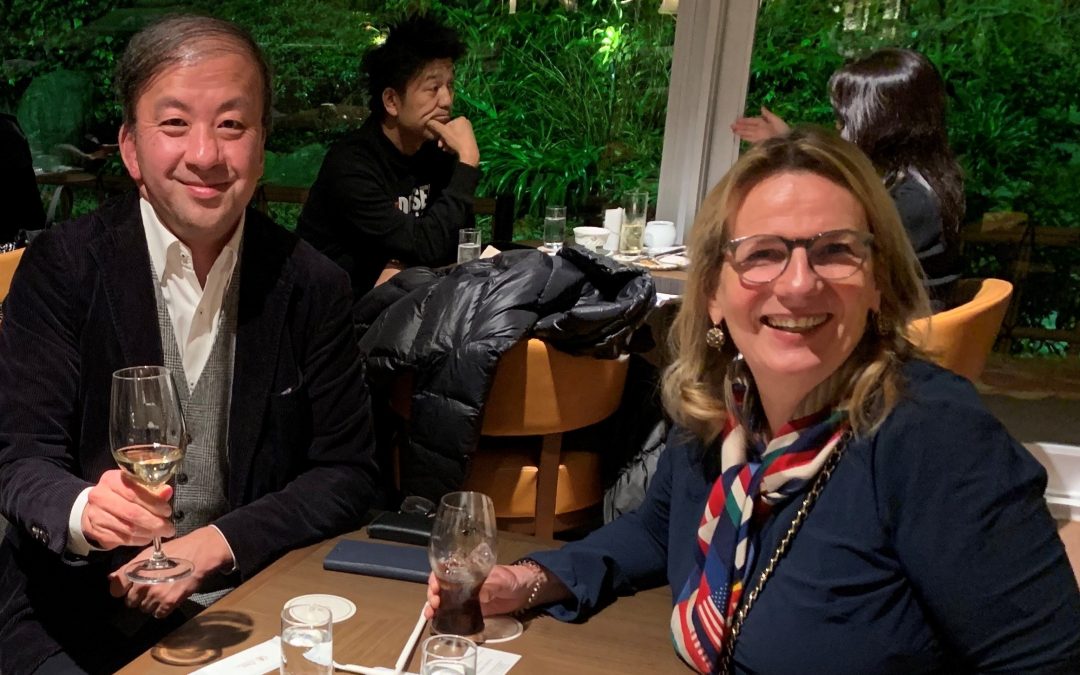
P.S.I met the Tall One, Manabu Moriya again in January 2020, when I did an assignment at Philips Japan. It was great meeting him again!
We aim to become an HPO, but we are not after more inclusion and diversity

We aim to become an HPO, but we are not after more inclusion and diversity

“Do you know there is another Esther Mollema? I am mainly interested in her. ”

An unexpected meeting with a board member of a prospect. Everything in his office radiated power and distance. I knew he was against the planned training on diversity and inclusion and had suggested canceling it. He did not see the point of it. The newly appointed diversity manager had asked me to help convince the board member that the planned training was a good plan.

The board member immediately told me that he had done his homework and googled me. He complimented me on my extensive and interesting experience in diversity and inclusion experience. After which the conversation took an unexpected turn. “Do you know that there is another Esther Mollema in the Netherlands? She knows a lot about a topic that is very important to us: High Performance Organisations. I am mainly interested in her. Do you know her?”

0.2 FTE on diversity

I was confused. Was this comment meant to be funny? I didn’t see a smile or a raised eyebrow, so I replied cautiously: “I am that Esther Mollema too. I have two specialisations: Diversity & Inclusion and High Performance Organisations. I am very interested in both, and the two areas have a big overlap. Both topics are mainly about good leadership.” 
Now he was a bit confused, but what followed was an animated conversation. After 30 minutes, he said: “I think you should come and tell us about both of these topics in our planned meeting”. He indicated that the team would be very interested in everything concerning HPO. But he didn’t think I would create much enthusiasm for the topic of more diversity and inclusion. The team considered those topics as a must-do for the organisation. Something particularly socially desirable that one could not openly oppose to. And something an organisation should not spend too much time on. The 0.2 FTE appointment for diversity was the hard-fought decision taken on this subject during the previous board meeting. The last thing I heard him say when I walked down the hallway was: “You get exactly two hours to convince us.”

Get rid of the hypes: the HPO model

During the training, I immediately took up the High Performance Organisation model. This model is the result of hard work by the HPO Center and especially André de Waal. Over a period of five years, he studied 290 scientific and management publications to identify the very characteristics for high performance. The HPO Center then tested the first models with more than 50,000 participants worldwide in 1,475 organisations. Statistical analysis of the data collected then showed that 35 characteristics are directly related to competitive performance. These characteristics were then grouped into five groups of HPO factors. He discovered that organisations scoring higher than their peer group on these five factors perform better than that peer group regarding financial and other criteria. Learning to use the HPO model will help you perform even better.

What is especially interesting is that the 35 HPO characteristics are stable over time and not subject to management trends. New hype words about management are added all the time, but the HPO model proves the management essentials’ consistent relevance.

GOOD LEADERSHIP IS ESSENTIAL

I explained how HPO Center started working with this model every day since 2008. The simple model is very rich and indicates what you should do and, just as interesting, what you should not. If it is not in the model, it has proven not to contribute significantly to an organisation’s result. Based on the HPO model, we examined organisations on their request. Together with their teams, we determined how they could perform better by a slightly different focus and adjusted actions.

Over time, we learned to use the HPO model more skilfully. We discovered patterns of inadequate interventions and time and again, we concluded how crucial good leadership is for an organisation. When more and more organisations started working agile and switched to self-management or self-organisation, the HPO Center continuously stressed the importance of good leadership because it proved that organisations perform better. No matter what the title is, be it leader, manager, coach, or agile team coach.

Some management and leadership tasks need to be well organised and performed to optimise collaboration and performance. The HPO model screams leadership. Listed under Quality of Leadership, twelve characteristics of the total 35 characteristics are included in the model. The other four factors also contain several characteristics that the leader must initiate. Overall, the success of 23 of the 35 characteristics is primarily determined by the manager or leader. In our opinion, good teams with bad leaders do not exist, just as bad teams with good leaders don’t exist. Good leaders make or break a team and the success of an organisation. As a result, the HPO Center’s statement is: without good leadership, no good result.

HPO MODEL AND DIVERSITY

Leaders largely determine the success of teams. They have two important assignments as a leader. One of the assignments is to provide clarity and allow speed to a team. This is where the leader  uses his or her power to make decisions, bring focus and create clarity so that people can do their work in an attuned, good and fast manner. A capable leader ensures rapid decision-making in which all alternatives are expertly considered. Diversity in teams can improve decision-making. Research has often pointed out that diversity in a team can lead to a better strategy, more creativity, and faster innovation. A diverse team appears to be better at weighing up the possible alternatives when making a decision. In a more homogeneous team, people come to a decision faster without looking at all the alternatives. As a result, you miss opportunities.

HPO MODEL AND LEADERSHIP: CAN YOU DO IT?

The other side of leadership is the inclusive part of it. This part of leadership involves paying attention to individual employees by helping, coaching, inspiring, and guiding them. These tasks are often less visible but of great importance for good performance. Of the 24 focus areas of leaders in HPO organisations, 9 are about using your power as a leader. No fewer than 16 are mainly about inclusive leadership: making everyone in a team feel at home.

ADJUSTING TO THE AVERAGE?

More than half of your leadership tasks help create an inclusive environment for all employees. This means an environment in which they feel free and open to express their ideas without feeling embarrassed or insecure. Creating this safety for all employees is a challenge, especially since all employees are different. Every individual requires a personal approach. This does not only concern visible diversity (e.g. gender, age, skin color) but also invisible diversity (e.g. social class, education, experience, attitude to life, preferred style). Tailoring to your team member’s individual needs takes time and attention, but it will certainly payback. Are you unable to make time to do these tasks properly? The consequence is, perhaps unconsciously, that you ask your employees to adapt to some sort of average. Everyone gives up a little bit of themselves to make it easier for the leader to manage. That seems like a good idea, but it seriously impairs performance. Those teams often cannot perform to the max. Tensions are not pronounced, dialogues are avoided, team members who are ‘good’ together form subgroups. Without good leadership in teams, prejudices often play a role. People act on their unconscious prejudices and therefore do not make the best use of each other’s talents. Taking advantage of diversity in teams requires the inclusion of all team members. Ensuring that team members do not have to adjust too much to an average gives a team a boost. And it is the leader who must make this possible.

COMMITMENT AND APPRECIATION 

Social psychologist, university professor at Utrecht University, Noami Ellemers, whose research I always follow, comes with several striking examples. “We looked at the functioning of cultural minorities in the workplace, for example among Muslim women. If encouraged to adapt to the majority, these women felt less engaged in the work and had less ambition to perform well or progress to a higher position. Only when they felt that their cultural identity was valued and they were allowed to be themselves did their work motivation increase. Paradoxically, once valued, they turned out to be more willing to meet the wishes of the organisation. We saw a similar pattern among gay employees. Those who did their best to fit in by hiding their sexual preferences and behaving like others performed worst. In general, we see that attempts to hide a stigma make people feel less satisfied and engaged at work. They experience shame and guilt about what they are trying to keep hidden, and therefore function less well among their colleagues. Those who ‘come out’ eventually feel more accepted and involved and collaborate better – because they no longer have to hide anything.”

IT DOESN’T ALWAYS WORK 

An HPO manager ensures inclusion works and keeps learning, every day. Every time a team changes composition, a new search begins to get to know each other, to provide the new team member with a safe environment, and to adjust the team’s ways to give the other person space. Just as sports coaches do with a new player in a team, so do HPO leaders in their teams. You can imagine that an active leadership task is much more extensive than that of a leader who has only led homogeneous groups of  people. A meta-survey in the US showed that in organisations where white men traditionally dominated, more diversity often did not lead to better results. Benefiting from diversity requires a lot of attention from the leader, especially if this leader has little experience with inclusion and diversity.

INCLUSION INSTEAD OF QUOTAS

A lot of attention for inclusive leadership is needed to hire the best talent (however diverse) and to build an HPO with these people. Building High Performance Organisations is strongly linked to creating inclusion and inviting diversity to really participate. In building a strong organisation, the focus should not be on the degree of diversity, as quotas do. The emphasis should then be on the way in which managers deal with differences between employees in teams. In an inclusive climate, they communicate to employees that differences are necessary and useful. They do not expect everyone to behave exactly the same, and as a result, all employees will feel part of it, and they will combine their contributions to improve collaboration and performance.

“First, we will have to do it ourselves!”

The workshop took place one week after my conversation with the board member. As always before a training session, I arrived with a curious attitude and some light ‘pre-game’ tension. Would the members of the board recognise the link between success as HPO and diversity and inclusion?

We managed to start the dialogue and just before two hours had passed one of the members of the board said: “We have serious work to do. We are those leaders who have far too little experience with diversity and inclusion. With our leadership style, we are very good at wasting diverse talent. It is not the diversity manager who has work to do, we have. It has to start with us.” On the face of the board member that I had spoken to one week before, a cautious smile emerged. “Let’s start with a training inclusive leadership for ourselves,” he said. “It will start with us.”

The first step was taken and proved to be a success. Their journey kicked off with focussing half a day on the unconscious bias with revealing test results. And all board members started working with the results of our feedforward analysis™ which gives insight into their individual qualities to achieve inclusion. These leaders gain new insights via this 360-degree tool based on HPO. Exciting and fun. I’ll speak to the team again next week.


Factor 1: Quality of management

Features that make the difference:

  1. The management of our organisational unit enjoys the confidence of everyone in the unit.
  2. The management of our organisational unit is honest.
  3. The management of our organisational unit has an exemplary role for its employees, it walks the talk.
  4. The management of our organisational unit takes decisions quickly.
  5. The management of our organisational unit takes action quickly.
  6. The management of our organisational unit coaches employees to achieve better results.
  7. The management of our organisational unit is focused on achieving results.
  8. The management of our organisational unit is effective.
  9. The management of our organisational unit consists of strong leaders.
  10. The management of our organisational unit radiates confidence.
  11. The management of our organisational unit is decisive in dealing with employees who perform ‘below par’.
  12. The management of our organisational unit always holds employees responsible for their results.


Factor 2: Openness and action orientation

Features that make the difference:

  1. In our organisational unit, management often enters into a dialogue* with employees.
  2. Employees in our organisational unit spend a lot of time exchanging knowledge and learning.
  3. Employees in our organisational unit are always involved in important organisational processes.
  4. In our organisational unit, management allows mistakes to be made.
  5. The management in our organisational unit is open to change.
  6. Our organisational unit is performance-oriented.

Factor 3: Long-term focus

Features that make the difference:

  1. Our organisational unit maintains good long-term relationships with all stakeholders (customers, suppliers, partners, etc.).
  2. Our organisational unit is focused on the best possible service to its customers.
  3. The management in our organisational unit has been working for the organisation for a long time.
  4. New management grows from within the organisation.
  5. Our organisational unit forms a safe working environment for employees.

Factor 4: Continuous improvement and renewal

Features that make the difference:

  1. The entire organisation has a strategy that is clearly distinct from other organisations.
  2. Work processes are constantly being improved in our organisational unit.
  3. Work processes are continuously simplified in our organisational unit.
  4. In our organisational unit, the work processes are continuously coordinated.
  5. All that is relevant for achieving good performance is reported to our organisational unit.
  6. In our organisational unit, relevant financial and non-financial information is made available to managers and employees.
  7. Our organisational unit continuously improves its core competencies.
  8. Our organisational unit constantly renews its products, services, and processes.

Factor 5: Quality of the employees

Features that make the difference:

  1. The management of our organisational unit encourages employees to achieve very good results.
  2. Employees in our organisational unit are continuously encouraged to strengthen their flexibility and resilience.
  3. Our organisational unit has diverse employees and our staff is complementary to each other.
  4. Our organisational unit creates growth through collaboration with other organisations.

Box B: Characteristics of inclusive leadership in the HPO model

  • Enjoying the confidence of employees
  • Acting with integrity
  • A role model
  • Coaching
  • Seeking dialogue
  • Make time for knowledge exchange and learning with the team
  • Involving employees in important organisational processes
  • Stimulating a growth mindset: together learning from mistakes
  • Open mind to change
  • Maintaining long-term relationships with all stakeholders
  • Focus on the best possible service to customers
  • Loyalty to organisation
  • Focus on employee development and growth
  • Creating physically and psychologically safe teams
  • Encouraging employees to achieve excellent results stimulates flexibility and resilience of teams and employees


Sources

  • www.hpocenter.nl
  • www.feedforwardanalyse.nl
  • www.mindbugstest.nl
  • The Role of Context in Work Team Diversity Research: a Meta-Analytic Review, Joshi and Roh, Academy of Management Journal, 30 November 2017
  • Diversiteit op de werkvloer heeft pas meerwaarde als verschil er mag zijn, Noami Ellemers, Sociale Vraagstukken, 26 January 2018

Philips: Diversity is a business imperative

Philips: Diversity is a business imperative

Hans de Jong, president of the Philips Netherlands, recently hosted the Top Women event. We support Philips worldwide in their ambitious diversity and inclusion goals.

“You can only successfully improve the lives of people worldwide if you reflect those different target groups yourself. Diversity is a business imperative, ”says De Jong. “When it comes to influx, the male / female relationships at Philips are in balance. We currently have 23 percent women in senior leadership positions. No, we are not satisfied with that yet, that should be 25 percent in 2020 and then gradually increase to 30 percent. We are concerned with better balance across the board, not just at the top, not just gender diversity. The point is to harness the power of the difference, and those differences are much more diverse than what we can see from each other’s looks. We also pay a lot of attention to inclusivity. After all, inclusivity is a precondition for taking advantage of the diversity that our colleagues bring. ” “Part of that is to tackle bias, or the unconscious prejudices that we all have as humans. We are often insufficiently aware of the influence of our own bias. It is much larger than we think or even want to recognize.

Within Philips, Astrid Balsink, our Global Head of Diversity & Inclusion, helps to promote this topic in all parts of the world. Worldwide she collects what is going on and what needs to change. This is not an easy task, since bias manifests itself differently in India than in the Netherlands, for example. So it is first of all about raising awareness. Programs follow to discuss and improve it at team level. In short, this is a long-term effort, which revolves around openness, dialogue, and learning from and with each other. ”

Read the entire article on Topvrouwen.nl.
Source: Topvrouwen.nl Author: Nicole Gommers

The four basic conditions for improvement – for leaders, teams and organizations

The four basic conditions for improvement – for leaders, teams and organizations

‘Leaders are not paid to preside over the inevitable… they are paid to make happen what otherwise would not have happened.’
– Sumantra Ghoshal, author of Bias for Action.

Why does one organization or team manage to improve and others not at all? How can you ensure improvement does succeed timely?  Our work High Performance Organizations (HPO) taught us the 4 basic conditions for improvement. The more you meet these basic conditions, the greater the chance that you will achieve your solid improvement objectives within a set timetable.


Is to what extent does your team or organization meet these four basic conditions for improvement?


1. Your organization is proven agile and aimed at improvement

The first question you have to answer for yourself: how well has your organization and team managed to adapt to new circumstances quickly, flexibly and resilient in recent years? Did that go smoothly or was there a lot of resistance, ambiguity and delay? Here are a few questions to estimate the agility of your team or organization:

  • Can teams easily discuss everything and search together to get a little better every day? Or do we prefer to stick to how we’ve always done it and do much bigger reorganizations of “accumulated misery” need to be done right?
  • Are managers and employees willing to change their habits because new circumstances call for new ones? Or are managers and employees keen to keep everything the same?
  • Is there great confidence in each other and in teams that they can jointly meet the challenges of the future? Is there enough confidence in teams to believe they can handle tough challenges too? Or are people negative and anxious about the future and their position?Making an improvement plan work requires a “strong” organization: teams that can change and improve together. Weaker or more anxious organizations or teams have more difficulty adjusting the ways they work and change more slowly and shockingly. For them, the journey to improvement in teams is much more difficult, slower and with more ups-and-downs.

2. There are inclusive leaders, willing to learn

The second important question is whether the leaders of the organization fulfill their management and leadership tasks with attention and pleasure. One of the indicators we use for this is to ask what leaders and managers do themselves to learn about and improve the profession as manager and leader. Do they read books about it? Do they go to training courses? Or do they only visit mandatory training organized by the organization? Or is there even resistance to that?

Leaders who are developing themselves have long known that their behavior and habits largely determine the success of a team. There are no very successful teams with bad leaders or very bad teams with good leaders in the long run. The exemplary behavior of the leader largely determines the behavior of employees. Much more than we assumed until now. Our brain is a social brain and focuses very much on functioning in the group. A leader who regularly examines himself and adjusts his or her behavior will see that the adjusted behavior is adopted. The leader’s habits are “contagious.” A leader who adapts his own habits will thus adjust the behavior and culture of a team. Improvement requires attention in teams and the leader. Leaders who take their job seriously will better understand and act on the challenges of improvement.

3. There is a growth mindset

Some people believe that their talents and abilities are fixed qualities. They have a certain amount of it (“a lot of discipline”, “little mathematic insight”) and that’s it. This fixed mindset can limit people in their success. They focus on proving their talents and abilities on the one hand, and hiding shortcomings on the other. They react defensively to mistakes or setbacks, fearing that they would indicate a lack of talent or talent. They are also more likely to miss important career development opportunities. They see them not so much as an opportunity for learning and growth, but as a risk of failure.

In contrast to this, the growth mindset, people believe that they can develop their talents and abilities through commitment, training and perseverance. Their focus is not on appearing smart, or on brushing up their image. They are eager to learn, dare to take advantage of opportunities and learn from the results. They enjoy working with people who challenge them to grow, they dare to look honestly at their shortcomings and they look for ways to improve them.

Carol Dweck, professor of psychology at Stanford University, is the founder of this theory. She states that the way you see your own talents and skills determines to a large extent how these will develop. All this also means that the best strategy is not to simply hire the most skilled people we can find; but above all to look for people who embody not a fixed, but a growth mindset: a love for learning, an openness to feedback (positive feedback, read feedforward) and the ability to face and overcome obstacles.

Improving your team or organization is a bumpy road that requires a growth mindset from the people in the organization. Things will change, things will go wrong, but as long as we learn from it it will make us better.

4. Show courage at the decisive moments

You may still want to improve, but the point is that you really choose it if you can. Do you choose diversity when you put together a new project team? Do you go for growth mindset even when things go wrong? As a leader, will you continue to give confidence even if it is difficult? Do you focus sharply on what we do and don’t do? Do you dare to follow your plan as a leader or is it too exciting when the pressure from outside or the top of the organization becomes high?

What you do as manager and team in these fearful moments as a manager and team, or what you really want to happen, no matter how difficult it sometimes is. In some organizations you sometimes see the lack of courage to really do what you say you believe in. In these organizations, leaders and teams lack many opportunities to improve and will therefore not improve.

Which of the four basic conditions is in good shape in your team? Which one can you work on? Do you meet the four basic conditions for improving your team?

Let us know! We are happy to help you.

Esther Mollema interviews Anna Fels

Esther Mollema interviews Anna Fels

During a visit to New York, Esther Mollema interviews Anna Fels, author of the book Women and Ambition.

Let’s talk.. about ambition

Many women seem to have a difficult relationship with ambition. They are ambitious, but they often don’t say it (enough). Esther talked about this with Anne Fels ( American ) who did research on this topic. Anna Fels en Esther Mollema At the end of your performance interview, your boss asks about your ambitions for the following years. What are you doing? Do you immediately come to the point with a concrete proposal, such as: “I would like to grow into a senior position in two years’ time and lead my own team”? Or do you say, “I don’t really know. I want to grow in content and develop myself personally, but I don’t know how exactly. ” Are you asking for a deserved promotion? Or are you waiting for your boss to offer it?

In my experience (Esther ed.) many women still find it difficult to indicate clearly what they want. And that’s why I got on a plane to New York to speak to Anna Fels, who gave so many insights about this in her book “Women and Ambition“. She conducted a major research into dreams and ambitions, and what they mean to us.

The many women she interviewed for her book all spoke fluently and candidly on everything from money to sex. But when it came to their ambitions, it suddenly became difficult! And yet ambitions fulfill a deep human need. Whether teaching, healing patients or a career in business: being good at something and getting recognition for it is essential to our well-being and happiness. For women of today, the road to something good is wide open. We have access to all courses and professions. However, the pitfall is still in recognition, says Anna Fels: “that is still more difficult for women than for men.”

Anna Fels,if ambition is so good for us, why is it often such a difficult subject for women?

“Women’s roles are changing at an unprecedented rate, probably more than ever in history. Cultural values ​​that were valid for centuries are broken. But those values ​​still have an impact. In the past, women often had to subordinate themselves to others. There was little room for themselves. That is still the case with many women.

Many women feel guilty if they want to do something for themselves, for example promote while they already have a nice job, or if they want to work more hours. Wanting to make a career, being ambitious, is then considered to be very selfish. Women often hide their ambitions. I even see here in New York, the epicenter of ambition, few women who are truly openly ambitious.

Women who are successful often say that it just happened that way and that they were very lucky. ” Despite all the changes in recent decades, it has proved difficult for women to maintain their ambitions, says Anna Fels. Because we still expect women, whatever their dreams, to be primarily caring and supportive to others. So a tricky pitfall…

Following your dreams and ambitions makes you happier, but “real women” and “good mothers” should (we still think) not choose for themselves. Of course that is changing, but in almost all women today you can still see some of this internal struggle.

Anna Fels, what can women do themselves to stick to their ambitions?

“Everyone needs encouragement and attention for his or her ambitions to be motivated and productive. I often see women who do not receive this encouragement in my practice. I show them that they are in an environment where they receive very little support. That they must stop trying to change themselves and that breaking them is not personal failure, but simply the best, inevitable choice.

The solution is not to stay where you are, but to find a new job, a new environment, a new mentor. Cut your losses and get out! My second most important advice is that in such a situation you should not so much look for a new job, but especially for a new boss. Someone who does give you support and recognition. Also look at the people who already work for this person. Is that the environment in which you fit and will flourish?

I hope that women will support each other much more in the coming years by letting each other know for whom you should and should not work in an organization. I hope there will be more networks in which women discuss this with each other.

Anna Fels: “For men a lot is changing too”

In my work I see that more and more men are starting to make new and different choices. How do you also recognize that?

“For men, this major cultural change is also getting more exciting. Until now they have had much clarity. Men did not receive negative feedback in their choices, for example to make their careers more important than their families. But a lot is changing for them too: 35 percent of women in the US are already earning more than their husbands. And in the last recession, especially men have lost their jobs. Those families already live in a new truth. ”

In the Netherlands, I (Esther ed.) advise many companies that want to prepare their women and men for a more diverse composition of their organization. How well does that work in the US?

“We have known for some time that organizations with a good male / female ratio perform better, but it develops still slowly. A bright spot is that it is a real culture revolution and if you look at it that way, it all goes quite fast. But if you experience it yourself, you can be annoyed by that slowness, yes.”

As a mother, what can you do to prepare your daughters for these new choices and lives?

“Parents who want to help their daughters to choose new, less traditional roles should especially teach children how to become good at something. Children like to feel special and special, to be proud of themselves. It doesn’t really matter what, but they have to feel that they excel at something. And for recognition, the compliments of just your parents are not good enough.

Children quickly realize that parents are not really objective. They must get the signal from the outside world that they are good. Parents can of course organize this carefully. By looking for their talent with their children and then ensuring that they receive compliments from others. ”

Esther Mollema’s books can be ordered via bol.com