This article is an update of two previously written blogs on the same topic. In this article, we look at why daring leaders are unable to deliver on the many transformations in organizations and how caring leadership can be trained through micromoments.
Good leadership is often described in terms of styles, competencies and models. In practice, however, I see something much simpler: effective leaders stand firmly on two legs.
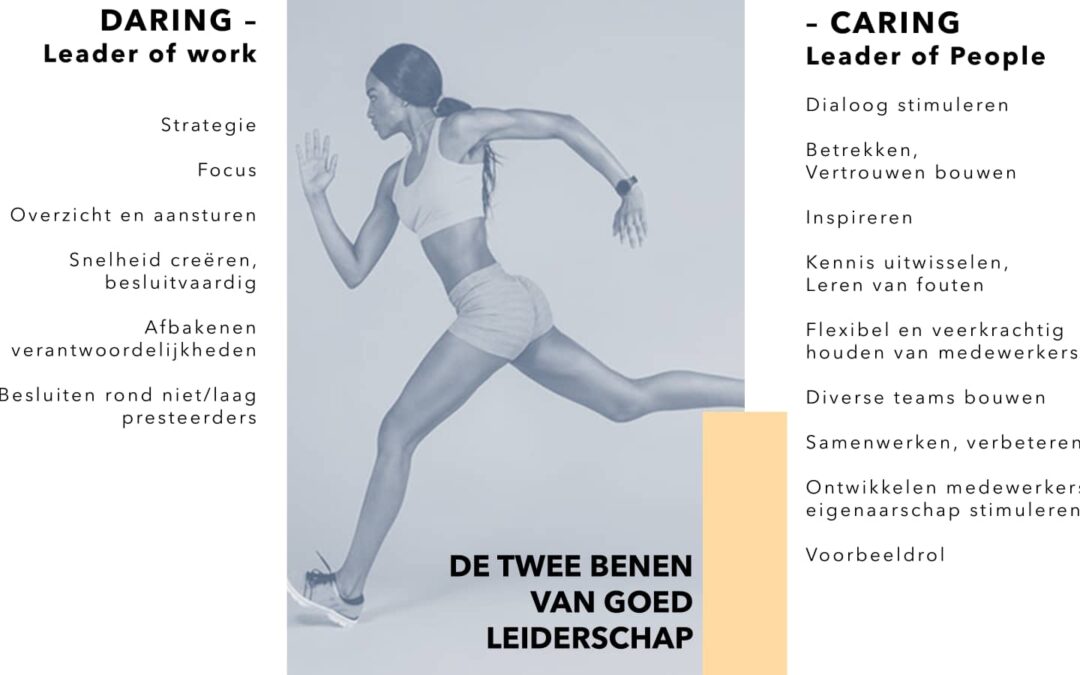
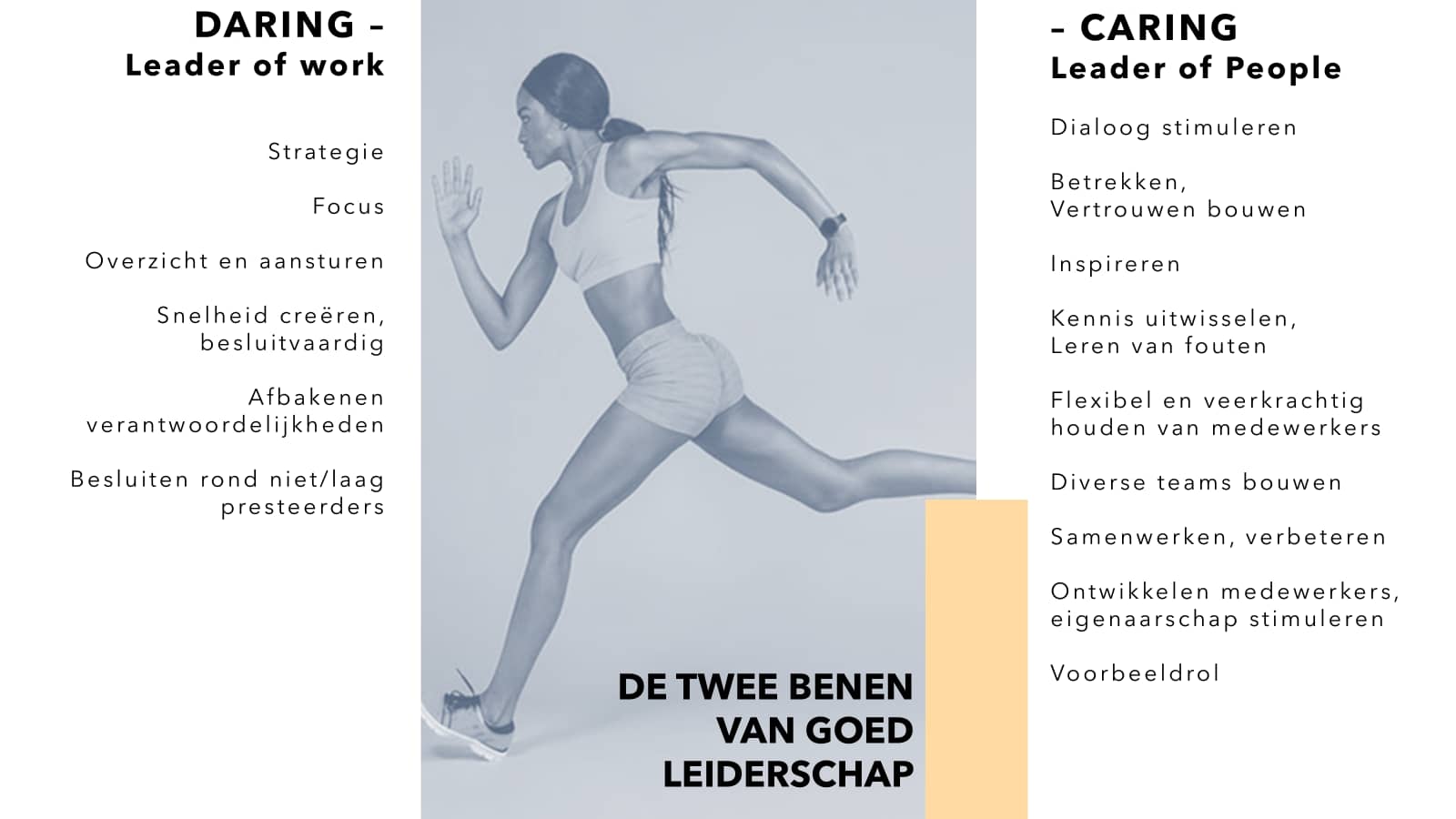
I call those two legs daring and caring. Together, they form the foundation of good leadership. They are not separate qualities you can choose from, but two connected tasks. One cannot exist without the other. Only together do they enable leaders to make progress and achieve sustainable results in teams and organizations.
Leadership on two legs
One leg represents what I call the daring side of leadership: the ability to provide direction, make decisions and take responsibility for the collective result. Daring leadership means consciously using the formal power you have been given in your role to move the work forward. With this leg, you create clarity, focus and pace as a leader. You make clear what matters, which choices are being made and what is expected of people. You prevent topics from floating around, address what needs to improve and make sure that agreements are not only made, but also followed up on. Of course, you discuss a lot with the team and listen to different perspectives. But leadership also requires you to make decisions on time. Not endlessly continuing to consult, but offering clarity about what will and will not happen. Because ambiguity can sometimes feel kind, but in practice it often leads to delay, frustration and hassle.
The other leg represents the caring side of leadership: the ability to pay attention to people, their development and the quality of collaboration. Caring leadership means that you do not only look at what needs to be done, but also at what people need in order to contribute well. With this leg, you create an environment as a leader in which team members can grow, learn and dare to share their perspective. You listen actively, ask questions, coach where needed and help people develop their talents further. This creates a way of working together in which people feel seen, strengthen one another and learn from one another more easily. That attention to the human aspect ultimately makes decisions better. Not because every feeling should be leading, but because good decisions also require insight into what is going on with people. What concerns are present? What knowledge is still left unspoken? Who is looking at the problem from a different perspective?
The model of these two legs emerged for me in 2022, thanks to Joy Lodarmasse from Alliander, who introduced the metaphor. By now, it is used by many organizations and coaches, precisely because it makes clear in one image what good leadership requires: not a choice between caring and daring, but the development of both qualities in connection with one another.
In practice, however, we see that many leaders mainly develop one of the two legs. Often, this is the behaviour that made them successful in the first place. The leader who is good at connecting keeps caring and aligning. The leader who is strong at giving direction keeps pushing and making decisions. What was once a strength eventually becomes a limitation.
Good leadership therefore requires not only becoming stronger in what you can already do, but also developing the leg that feels less natural. That is where balance emerges.
Both legs in practice
Over the past years, my conviction has only grown stronger: organizations still focus too little on caring leadership, while the pressure on leaders is greater than ever. For a long time, leaders were mainly selected and rewarded for their daring qualities: giving direction, making decisions and achieving results. In many organizations, we therefore see senior leaders who are good at this. They develop strategy, create focus and ensure pace. This has brought organizations a lot, and for a long time it also seemed to be the route to success.
At the same time, an increasingly visible problem is now emerging. This particular group of leaders often struggles to make major changes truly succeed. Not because the plans are wrong, but because there is insufficient insight into what is happening among the people who have to carry out those plans.
Research has shown for years that a large share of organizational changes fail or fall short of expectations. The cause rarely lies in the strategy itself, but much more often in the way people are taken along. Or more precisely: in the extent to which leaders understand what is happening beneath the surface. Daring leaders often genuinely feel that things are going well. The direction is clear, the planning is in place and the goals are clear. But doubt, uncertainty or resistance are not always expressed. And what is not expressed is quickly interpreted as not being there. Silence is not agreement. That is exactly where things go wrong. What feels to leaders like “silence” or “agreement” is in reality often hesitation, lack of clarity or a lack of safety to speak up. Signals that are crucial for the success of a change therefore remain invisible.
In organizations where several changes are taking place at the same time, and there are many of them, this gap only grows wider. The difference between leaders who are strong at giving direction and the lack of attention for what is happening among people becomes increasingly tangible.
The thinking error of a generation of daring leaders
An important part of this problem lies in the way we have defined leadership for a long time. Caring was often seen as something extra: a team outing, an inspiring speech or a moment of attention at set times. Not a core part of leadership, but something added on.
In addition, daring leaders in the Netherlands operate in a specific cultural context. We communicate relatively directly and explicitly. What is not said quickly seems not to exist. But that is exactly where the thinking error lies. In many situations, what people really think or feel is precisely not expressed directly. Not because it is not there, but because it feels tense, because the context does not feel safe enough, or because people have not yet found the right words.
Leaders who lean heavily on daring miss this layer more quickly. They mainly listen to what is being said, while a large part of the information lies precisely in what is not being said. In more group oriented and caring cultures, leaders are often more used to reading between the lines and picking up subtle signals. That ability is becoming increasingly important in complex changes.
What is not said determines what happens
When objections are not expressed, they often do not exist for others either, especially not for leaders who are strongly focused on results. At the same time, those unspoken signals contain valuable information.
Connection is found in the micromoments
Connection does not arise through large, visible gestures, but through what happens between people every day. In small, subtle signals during interactions. Often, it begins with a leader who shows something of themselves, dares to slow down and takes a vulnerable and learning stance.
Caring leaders act from the understanding that people perform better when they feel seen, heard and valued. Not as an extra, but as a condition for being able to do good work. In teams, people are constantly, often without being aware of it, looking for signals that confirm that they belong and that their contribution matters. That search does not stop after one good conversation, but returns again and again in daily work.
That need for connection is deeply rooted in our human system. We have no armour or claws. Our strength for survival lies in collaboration. Alone we were vulnerable, together we had a chance. That logic still influences how our brain responds, also in a modern work environment.
Micromoments: where the difference is made
Caring leadership becomes visible in what we call micromoments: small, often fleeting interactions that repeat throughout the day and have a major effect on the quality of collaboration. These are moments in which someone feels seen, in which someone is truly listened to, in which space is created for another perspective or in which something is named that has not yet been made explicit.
Precisely because these moments are so small and everyday, they are easily overlooked. They are not included in schedules, require no extra resources and are rarely evaluated explicitly. Yet they strongly determine how safe, engaged and energetic a team feels and functions. When these micromoments are present, a different dynamic emerges. People speak up, contribute ideas and take responsibility. When they are absent, hesitation and distance arise instead.
The difference often lies in seemingly small choices: a question that is or is not asked, a response that is or is not given, or the moment when a leader decides to pause instead of moving on. Caring leadership is therefore not a “soft” addition, but an essential part of effective leadership.
Daring reconsidered
The importance of caring does not mean that the daring leg becomes less important. On the contrary, especially in times of change, it is necessary for leaders to provide direction, make choices and ensure progress. Without that clarity, uncertainty and delay arise. At the same time, in a context of continuous change, it is no longer enough to be strong only in analysing and making decisions. Nor is caring leadership enough on its own.
The challenge lies in developing both qualities in connection with one another. When daring and caring reinforce one another, leadership emerges that both gives direction and creates connection. It offers clarity and leaves room for the input of others.
In practice, that balance proves difficult. Many leaders develop mainly along one of the two dimensions. What made them successful before can later become precisely what limits them.
Caring leadership is developed in practice
Caring leadership is difficult to develop through classical training alone. Knowledge and awareness help, but ultimately this form of leadership emerges in daily interaction with others. It requires attention and practice: listening to what is going on, staying curious and repeatedly asking yourself what the other person needs in order to move forward. That development does not only take place at work, but also beyond it. In every situation where there is a choice to either give attention or not. It is precisely in those micromoments that leadership takes shape. By recognizing them and consciously paying attention to them, new habits emerge.
Which leg do you stand on?
Leaders who are mainly strong in daring can be highly capable in terms of content, and still not be the leaders needed for the transformations organizations are now facing.
The question that helps here is simple: which leg do you mainly lean on as a leader? And how do the people around you see that? The invitation is to develop both legs. Not only in theory, but especially in daily practice. In the many small moments in which leadership becomes visible. The major changes organizations are facing are not only realized through strategies and plans, but through behaviour. In how people collaborate and how they interact with one another. Leaders who learn to see those moments and consciously shape them build, step by step, teams that not only perform better, but are also more resilient, experience more energy and remain connected for longer.